

To brief a Kolkata service business social media campaign, write down the service you want to promote, the customers and neighbourhoods you can serve, the action you want people to take, and the resources available. Then agree the content, budget, approvals, enquiry handling, and reporting before work begins. This gives social media marketing services a clear business purpose.
A campaign brief is a shared working document that explains what a campaign must achieve and how the business and agency will work together. It is different from a content calendar, which lists individual posts and publishing dates. The brief comes first and guides the calendar.
For a salon, that purpose might be appointment enquiries for one treatment. For an accounting firm, it could be consultation requests from suitable business owners. The starting point is a service people can understand and an enquiry the business can handle.
What should you decide before writing the brief
Choose one priority service and one main outcome. Trying to promote every service to everyone makes it harder to judge whether the campaign is useful.
Before approaching an agency, review recent customer enquiries, sales conversations, booking records, and previous campaign reports. Note what customers ask, why they hesitate, and which enquiries become paying work. Treat assumptions about your audience as hypotheses until this evidence supports them.
A campaign is easier to run when the business has a clear offer, available capacity, usable assets, and someone responsible for follow-up. If the booking process is broken or nobody can respond to messages, resolve that before increasing promotion.
Write an objective that sales can recognise
Replace “we need more engagement” with a specific commercial task: “Generate enquiries for our home deep-cleaning service from households in our confirmed service areas.” Then define what counts as suitable.
A qualified enquiry might require the right location, a service you actually offer, an achievable date, and an identifiable customer need. A message asking for a job is not a sales lead. Record a baseline and agree a target using actual capacity and past evidence; do not borrow another company’s numbers.
Define the Kolkata audience and service area
Describe the customer in terms of need, location, and buying situation. “Everyone in Kolkata” is rarely a useful instruction for a local service campaign.
For example, a home-service business may cover selected parts of South Kolkata but exclude other areas because travel affects scheduling. List the neighbourhoods or postcodes the operations team has confirmed. State whether nearby locations such as Salt Lake or New Town are included rather than assuming a city label answers that question.
Include:
- The service area and any excluded locations.
- The customer problem and the person who usually makes the decision.
- Preferred enquiry language and languages the team can support.
- Typical questions, objections, and reasons customers delay booking.
- Appointment availability, travel limits, and service restrictions.
Choose language from customer evidence
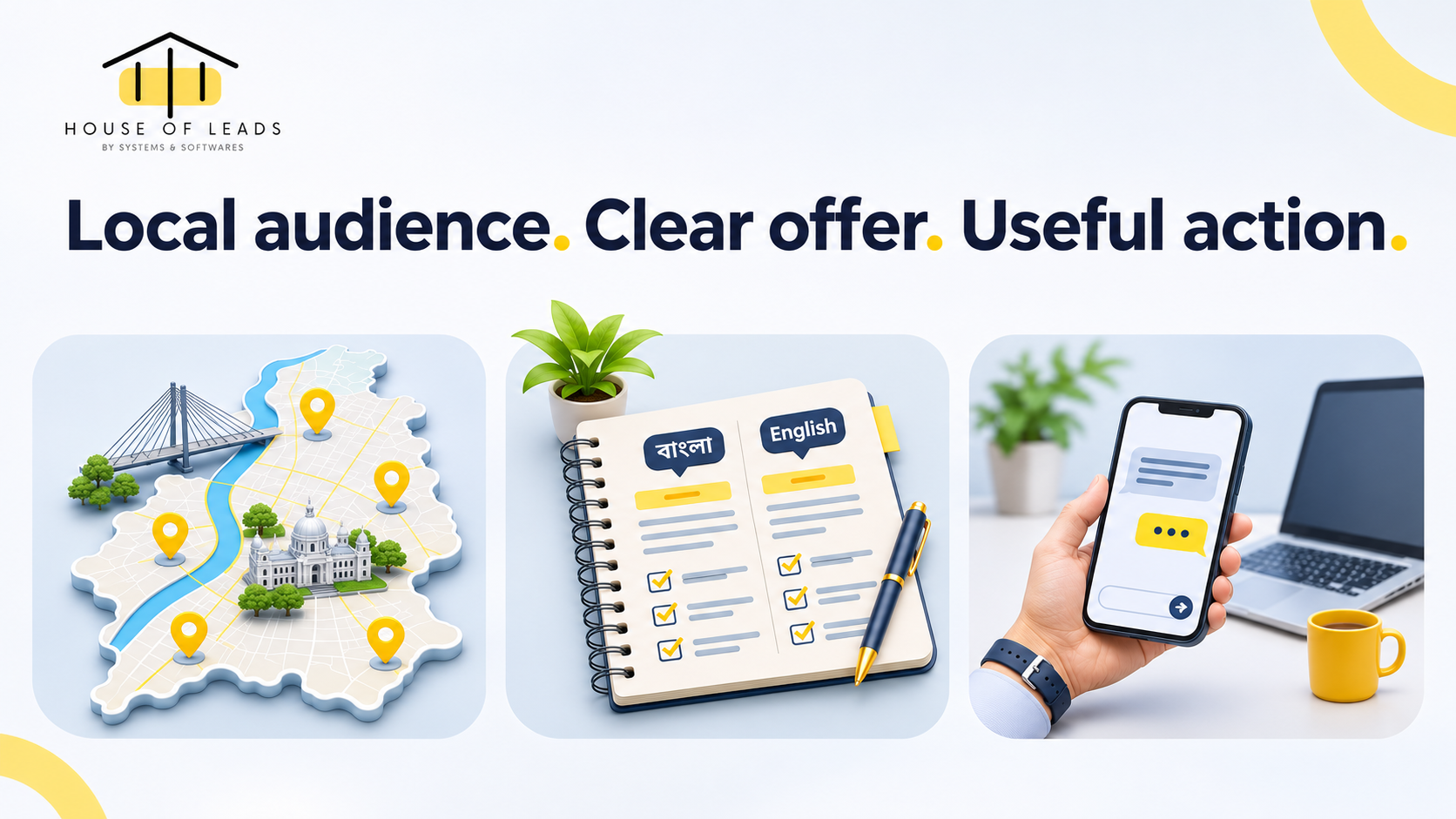
Do not assume every Kolkata buyer wants Bengali content. Review the language used in calls, messages, and existing customer conversations. English, Bengali, Hindi, or a considered combination may suit different audiences.
Specify whether you need translated captions, subtitles, voiceovers, or separate creative versions. Name the person who will check local wording and service accuracy. Translation and additional filming should be included in the scope before production starts.
Give the agency a clear offer and reliable proof
Explain what the customer receives, what is excluded, and what happens after they enquire. An offer does not need to be a discount. It could be a service assessment, a consultation, or a clearly explained appointment option, provided the business actually offers it.
Supply approved service descriptions, current terms, genuine team information, relevant photos, and permission-cleared customer material. Mark claims that still need checking. Do not ask the creative team to invent credentials, testimonials, outcomes, or scarcity.
For service businesses, useful content often answers a practical question: what happens during a visit, how to prepare, what affects the quote, or which jobs the company can accept. These topics help prospective customers decide whether to contact you.
Define the next step
Choose a main call to action that matches the offer: request a quote, book a consultation, or check appointment availability. Provide the actual destination and test it on a phone.
If an advertisement offers one service but links to a page listing ten unrelated services, the customer has extra work to do. The destination should explain the promoted service, service area, and contact process clearly. Confirm who can update the page if information changes.
Agree the scope of social media marketing services
State exactly what the agency will deliver and what your team will provide. Social media management may cover publishing and responses, while strategy, shoots, paid advertising, or landing-page work may require separate agreement.
House of Leads describes strategy, creative production, community management, and reporting on its service page, with paid social as an optional separate scope. Use the proposal to confirm the work needed for your campaign rather than assuming every activity is included. [1]
Separate organic content and paid distribution
Organic content can explain the service and keep the profile useful. Paid distribution can put selected messages in front of additional audiences, but requires its own media budget, setup, and measurement. Neither route guarantees enquiries.
Choose the mix around the objective and available resources. If you need enquiries by a fixed date, ask how the proposed plan addresses that deadline and what could prevent it. A content calendar alone does not establish a reliable acquisition forecast.
Use this scope comparison before accepting a proposal
Brief area | What to confirm | Decision it helps you make |
|---|---|---|
Platforms | Named channels and the reason for each | Whether the plan fits the customer |
Content | Formats, quantities, versions, and captions | Whether the fee covers the required work |
Production | Shoot locations, staff time, travel, and editing | Whether the business can supply the inputs |
Paid activity | Management scope and separate media spend | Whether the full budget is affordable |
Responses | Coverage hours, language, and escalation | Whether enquiries will receive useful replies |
Reporting | Definitions, data sources, and review dates | Whether progress can be assessed fairly |
Ask what is excluded as well. Influencer coordination, extra revisions, specialist translation, website changes, and additional shoots should not remain assumptions.
Set a realistic budget and working timeline
Break the budget into agency work, production, advertising spend, and any agreed external costs. Ask the proposal to identify applicable taxes and who pays each supplier. No universal campaign price is useful without a defined scope.
When resources are limited, prioritise one service, a focused audience, and content you can produce accurately. Expanding to more platforms increases the work needed for adaptation, approvals, and responses.
Build the timeline around dependencies:
- Business supplies approved service facts and available assets.
- Agency proposes the campaign approach and content plan.
- Business approves scripts, claims, and destinations.
- Team produces and checks the creative.
- Both sides test the enquiry journey before launch.
- Agency and business review performance and lead quality together.
Name a final approver and agree a feedback deadline. Decide what happens when approval is late. Silence should not be treated as permission to publish unless that arrangement is explicitly agreed.
Plan enquiry handling before the first post goes live
Assign an owner to each enquiry route and define when a conversation passes from marketing to the business. A good creative cannot confirm an appointment if the booking team has no availability.
Specify response hours, who can discuss pricing, how availability is checked, and how complaints are escalated. If the agency handles initial messages, provide approved answers and a clear point for human handover.
Use a simple lead record with enquiry date, campaign source where known, requested service, location, owner, stage, and outcome. Keep access limited to the people who need it. Collect only the information required for the next step; avoid asking customers to post personal details publicly.

Decide how the campaign will be measured
Measure the business outcome first, then use platform activity to understand what happened along the way. Reach, comments, and clicks can inform decisions, but they are not interchangeable with booked work.
For an enquiry campaign, agree these definitions before launch:
- Enquiry: a genuine request about the promoted service.
- Qualified enquiry: a request that meets the agreed suitability criteria.
- Booking: an appointment or job confirmed under the business’s process.
- Customer: a booking that becomes paid work, where the business can verify it.
Record agency and media costs separately. If you calculate media cost per qualified enquiry, divide advertising spend by qualified enquiries attributed under the agreed method. Label the calculation clearly; it does not represent the full cost of acquiring a customer.
Connect website visits with follow-up records
Google Analytics supports campaign parameters such as utm_source, utm_medium, and utm_campaign to identify referral campaigns in acquisition reporting. Agree consistent names before links are created. [2]
Website data will not explain every phone call, direct message, forwarded link, or later booking. Compare platform reports with the business’s lead records and ask customers how they heard about you when appropriate. Keep unknown sources visible rather than assigning every sale to social media.
Review whether the campaign is attracting suitable locations, relevant service requests, and realistic timelines. If enquiries are unsuitable, adjust the message or audience. If suitable leads do not book, investigate availability, pricing clarity, and follow-up before blaming the creative.
Example brief for a Kolkata home cleaning campaign
The following is an illustrative brief, not a House of Leads client campaign, package, or performance claim.
Business and service: A home-cleaning company wants to promote deep cleaning for occupied flats. Its operations team must approve the final service description and exclusions.
Audience and area: Households in confirmed South Kolkata service zones. The business will supply a postcode list and check enquiries from boundary locations manually.
Objective: Generate suitable quote requests. An enquiry qualifies when the property location is covered, the requested work is available, and the desired date can be assessed by the scheduling team.
Message: Explain what the service includes, what customers should prepare, and how a quotation is arranged. Avoid unverified hygiene or health claims.
Creative approach: Propose a service walkthrough, a preparation checklist, and answers to recurring customer questions. Obtain permission before filming a customer’s home. Confirm quantities and production requirements in the proposal.
Language and destination: Test English and Bengali versions if enquiry evidence supports both. Direct people to the approved service page or enquiry route, with the same service information across both.
Budget and ownership: Business to supply a budget range split between management, production, and advertising. The owner approves service facts; the agency prepares creative; the booking coordinator confirms availability.
Measurement: Review suitable enquiries, confirmed bookings, reasons for rejection, and known campaign sources. Establish targets only after reviewing the baseline and operational capacity.
This brief gives a team something concrete to plan and price. It also reveals what is still missing before launch.
Questions to ask an agency before you approve the campaign
Ask how the proposed work answers your brief, who will do it, and how changes will be handled. A useful discussion should reveal the agency’s reasoning, not simply its preferred package.
When comparing a social media marketing agency Kolkata businesses may shortlist, ask:
- Which audience assumptions need testing, and how will you test them?
- Which platforms would you prioritise for this service and why?
- What exactly must our team supply before work begins?
- Who checks service claims, translations, and customer permissions?
- How are revisions, extra production, and paid media charged?
- Who owns the accounts and receives access when the engagement ends?
- How will you distinguish unsuitable messages from qualified enquiries?
- What will you recommend if results suggest the offer or booking process needs work?
A brief can reduce uncertainty, but it cannot remove competition, changes in demand, platform variation, or operational limits. Be cautious about a proposal that promises fixed sales without explaining its assumptions and dependencies.
Campaign brief checklist before you send it
Use this final check to make the brief usable:
- One priority service and one main campaign outcome are named.
- Customer needs, service zones, and excluded locations are clear.
- Language choices are supported by actual customer information.
- The offer, exclusions, and call to action are approved.
- Supporting claims and assets are accurate and usable.
- Platforms, formats, quantities, and production responsibilities are agreed.
- Management fees, production costs, and media spend are separated.
- Launch dependencies, approver, and feedback dates are recorded.
- Enquiry ownership, response coverage, and handover rules are defined.
- Reporting definitions, baseline, review dates, and tracking limits are clear.
If something is unknown, label it as a decision to resolve during discovery. A clear gap is more useful than a confident guess.
Conclusion
A useful Kolkata service business campaign brief connects the offer, local audience, content, and enquiry process. It helps both sides agree what social media marketing services must deliver and how the business will judge progress.
To discuss a campaign with House of Leads, explore its social media marketing services in Kolkata. Share your company or website, priority service, target market, budget range, preferred timeline, and decision-maker. Those details provide a practical starting point for a scoped proposal.