
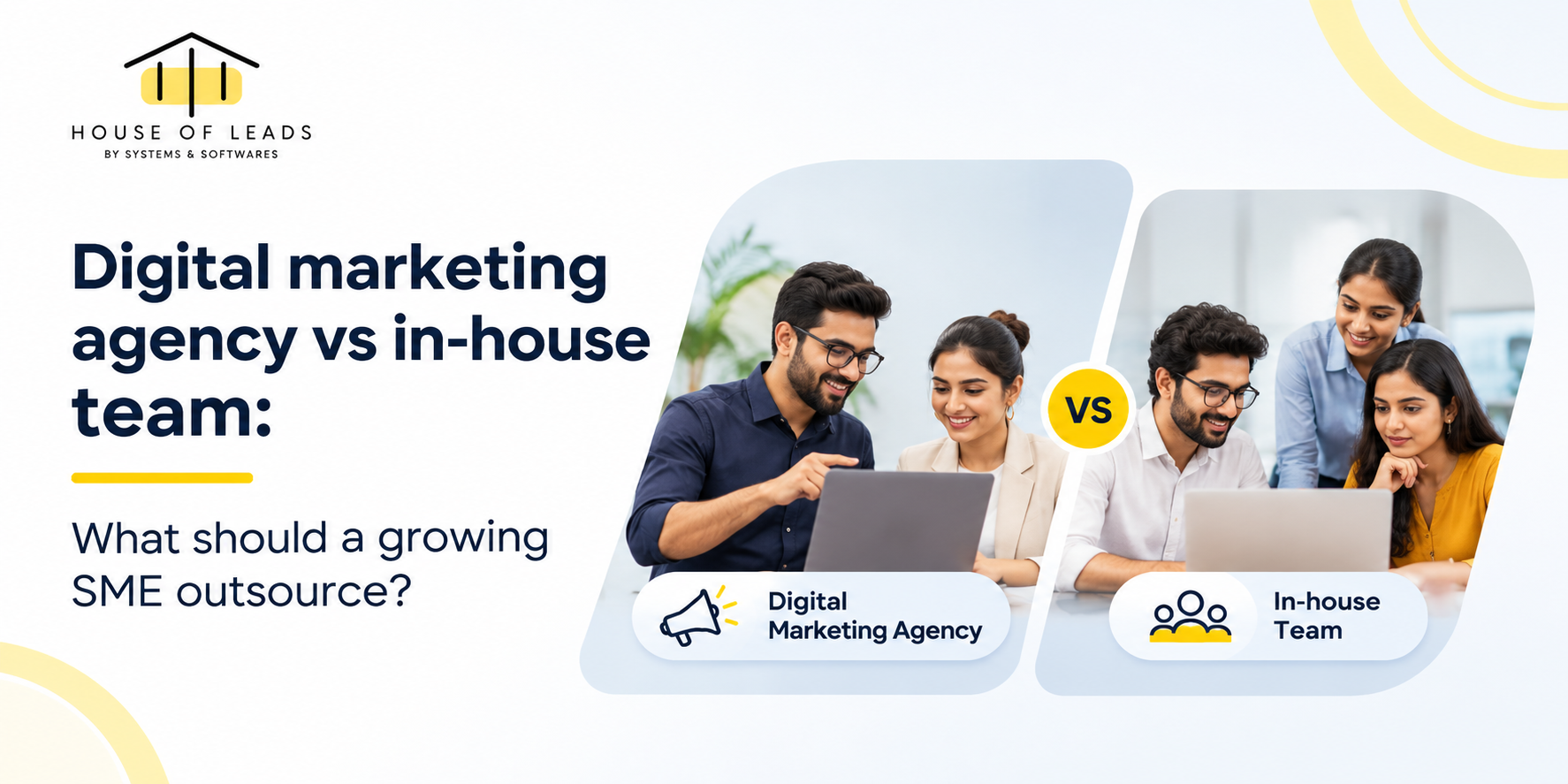
A growing SME should outsource specialist work it cannot deliver consistently, such as technical SEO, content production, social media creative, or a website rebuild. Keep business priorities, customer knowledge, final approvals, account ownership, and sales follow-up in-house. A hybrid setup lets one internal owner guide the work while a digital marketing agency in India supplies the skills or capacity the business needs.
When should you choose an agency, an in-house team, or both?
Choose based on how often the work comes up, how much it depends on business knowledge, and how many specialist skills it requires.
- Agency-led delivery suits a defined project or a mix of specialist tasks. It can work for a founder without a marketing hire if someone internally can brief the agency and approve decisions on time.
- In-house delivery suits steady work that needs daily coordination with sales, product, or customer support. A full-time hire makes more sense when there is enough recurring work to justify the role and the business can manage it.
- A hybrid team suits businesses that need internal direction and outside execution. For example, a marketing manager can own the plan while an agency handles technical audits, briefs, production, or development.
What should a growing SME outsource first?
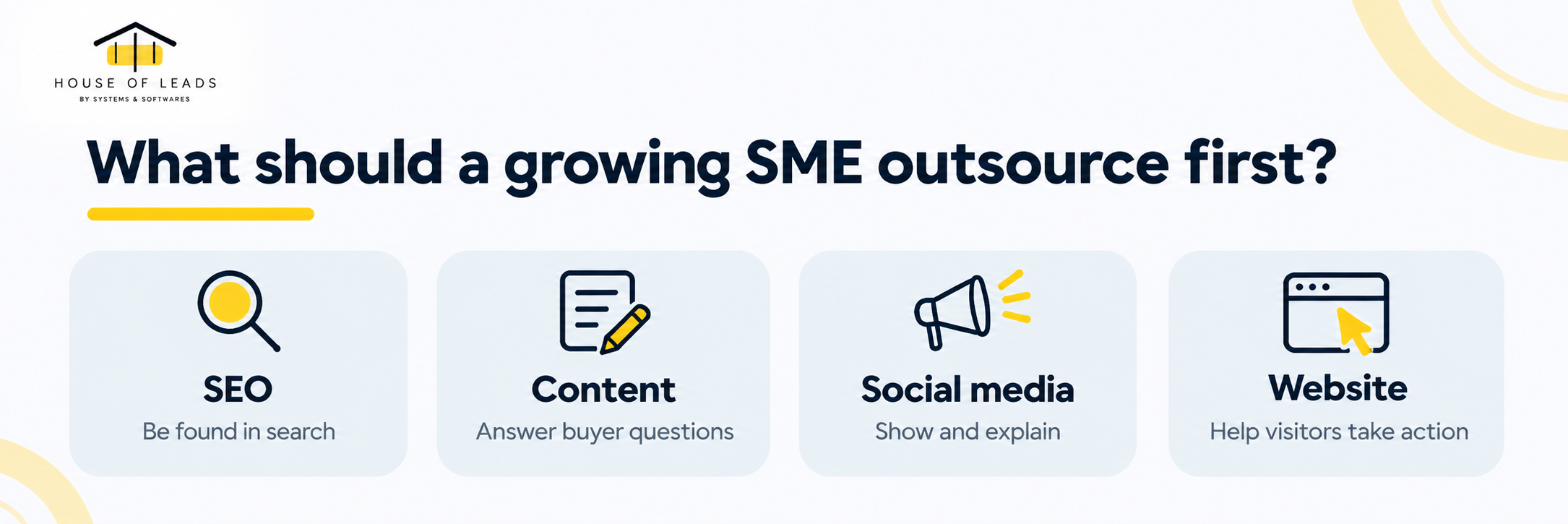
Start with the work that is holding up a measurable business outcome. If prospects find you but struggle to enquire, improve the page or form first. If the website works well but your main services are hard to find, start with SEO. If you already know which topics customers care about and production keeps slipping, consider outsourcing content marketing production.
Work | Agency can handle | Your team owns |
|---|---|---|
SEO | Technical audit, page priorities, and validation of agreed fixes | Priority offers and the decision to release site changes |
Content | Research, briefs, drafts, editing, and refreshes | Expert input, product accuracy, and approval |
Social media | Calendar, creative production, scheduling, and reporting | Brand voice, sensitive replies, and escalation |
Website | Design, development, mobile testing, and analytics setup in scope | Domain, hosting, user access, and launch sign-off |
What should stay with your team?
Give one person authority to set priorities, make decisions, and resolve delays. Have sales or support share common objections and examples of good enquiries. Keep company-owned access to Google Analytics 4, Google Search Console, Google Business Profile, your website, and your CRM wherever these tools are used. Give the agency role-based access and agree who handles approvals and handover before work begins.
How does your target market affect what you outsource?
As of 30 June 2026, TRAI recorded 1,114.17 million internet subscriptions in India, including 1,066.43 million wireless subscriptions. These are subscriptions, and one person can hold more than one. Use the national figures as context for testing mobile forms and landing pages. Use your own analytics and enquiries to pick the markets worth investing in. TRAI quarterly report
IAMAI and Kantar estimated 488 million active internet users in rural India in 2024. If expansion includes rural markets, use customer interviews and enquiry data to decide whether to test regional-language pages. A Kolkata service business can start with the neighbourhoods it actually serves. An e-commerce brand selling across India can prioritise categories and locations where stock, fulfilment, and returns support the offer. IAMAI and Kantar’s Internet in India 2024 report
How should you evaluate a digital marketing agency in India?
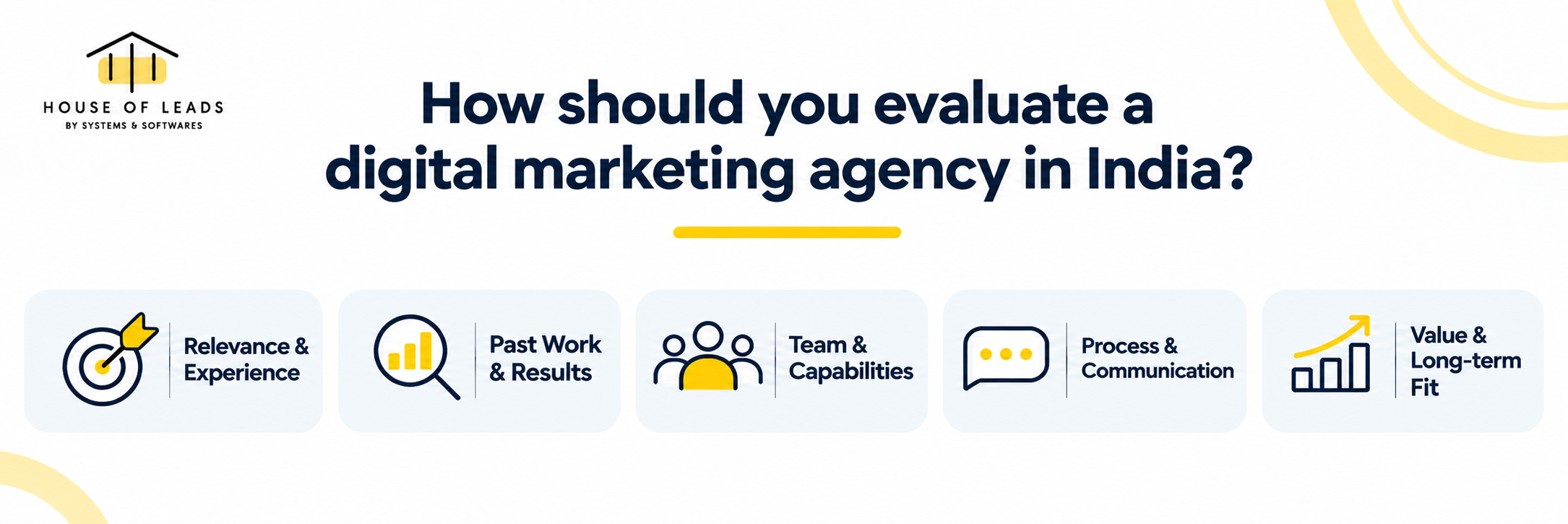
Give each provider the same brief. Ask any digital marketing company in India you shortlist to price that scope so you can compare proposals fairly. A comparable proposal shows what will ship, who owns the work, what your team must supply, and how both sides will judge progress.
- Deliverables. Ask for a sample month or project milestone. If the proposal includes an SEO audit, find out who implements the fixes and who checks them after release.
- People and approvals. Meet the person who will lead the account. Agree who approves drafts, how quickly your team can respond, and what happens when a dependency delays delivery.
- Full cost. Compare the agency fee, tools, production, and any applicable media spend with the cost of hiring, management time, and any specialist help a hire would still need.
- Market fit and evidence. If you are evaluating a digital marketing agency in Kolkata, ask how it would choose service areas and capture local lead quality. For India-wide work, ask how it would adapt by market or language. Request a relevant work sample and ask which results the agency can verify.
- Ownership and exit. Confirm access to accounts, published work, design source files, and documentation. Agree what gets handed over and when.
How should you measure the first 90 days?
Use the first 30 days to record a baseline, test enquiry tracking, and agree what counts as a qualified lead. In days 31–60, review what shipped and check that changes work on mobile. In days 61–90, review qualified enquiries, proposals, and pipeline alongside delivery. For an SEO engagement, also check whether the agreed fixes went live and whether priority pages are being discovered.
In the CRM, record source where known, service requested, market fit, budget range, timeline, decision-maker, and opportunity value when available. Track qualified leads and proposals by source. Record attributable pipeline as the value of open opportunities with a documented source. Keep unknown sources visible so the report reflects gaps in attribution.
What does a hybrid setup look like for a Kolkata SME?
Imagine a commercial cleaning business serving offices in Salt Lake and New Town. The owner answers enquiries and knows which contracts the team can service. The website has a generic service page and a mobile form that is difficult to complete. The owner has one afternoon a week for marketing.
- The business keeps control of its service areas, minimum job size, site photos, prices, approvals, and callbacks.
- The agency tests the form, drafts a clearer office-cleaning page, improves internal links, and agrees with the owner on who will implement and test the changes.
- Both review which enquiries fall inside the service area, which lead to site visits, and which turn into proposals. If leads keep coming from outside the service area, they review page messaging and targeting before increasing spend.
This is an illustrative example. An e-commerce team can use the same split by keeping inventory, margins, and promotional decisions internal while outsourcing category-page SEO or campaign creative.
What can you put in your first brief?
Use a short scope the agency can price and your team can manage. For the cleaning business, it could read:
- Goal. Generate more qualified office-cleaning enquiries from Salt Lake and New Town.
- Scope. Update one service page, improve one enquiry form, and test that form submissions reach the sales inbox and are recorded where agreed.
- Responsibilities. The owner supplies service details and approves copy. The agency names who builds and tests the changes and confirms when the page is ready to go live.
- Review. At the agreed check-in, compare qualified enquiries and proposals with the baseline. Confirm any follow-up work before expanding the scope.
Conclusion
Outsource one bottleneck first and assign an internal owner before the project starts. Put the deliverables, approval process, account access, and review date in writing. Expand the scope once the team can show what shipped, what changed, and what still needs attention.
House of Leads, a digital marketing agency in India, offers SEO, content marketing, social media marketing, and website development. Its published content scope includes editorial planning, landing pages, and content refreshes. If you want a proposal, share your company and website, the service you need, your target market, budget range, timeline, and who will approve the project. Request a House of Leads consultation.