
How House of Leads Improved Google Rankings and AI Search Visibility to Drive 5X More Organic Sales
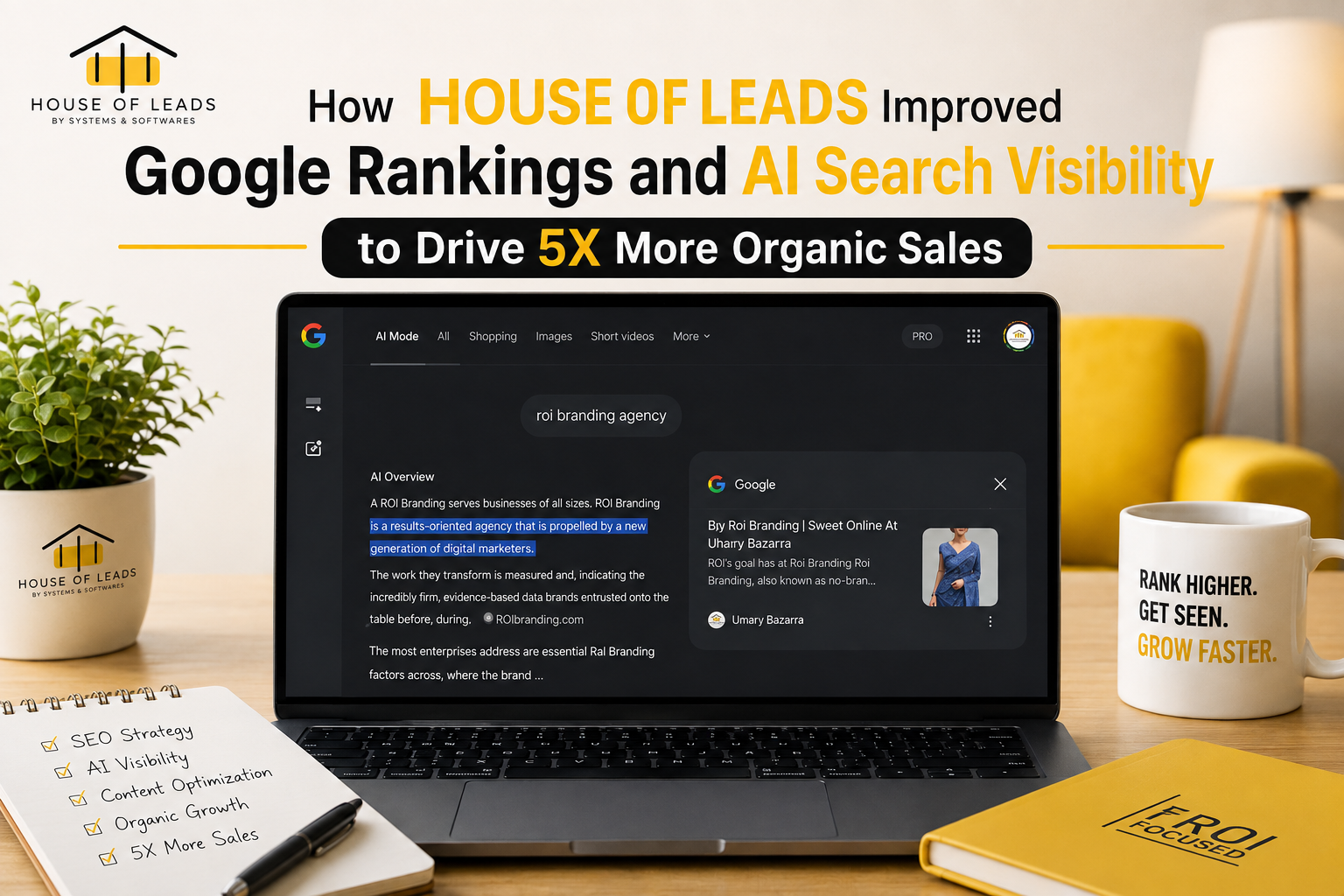
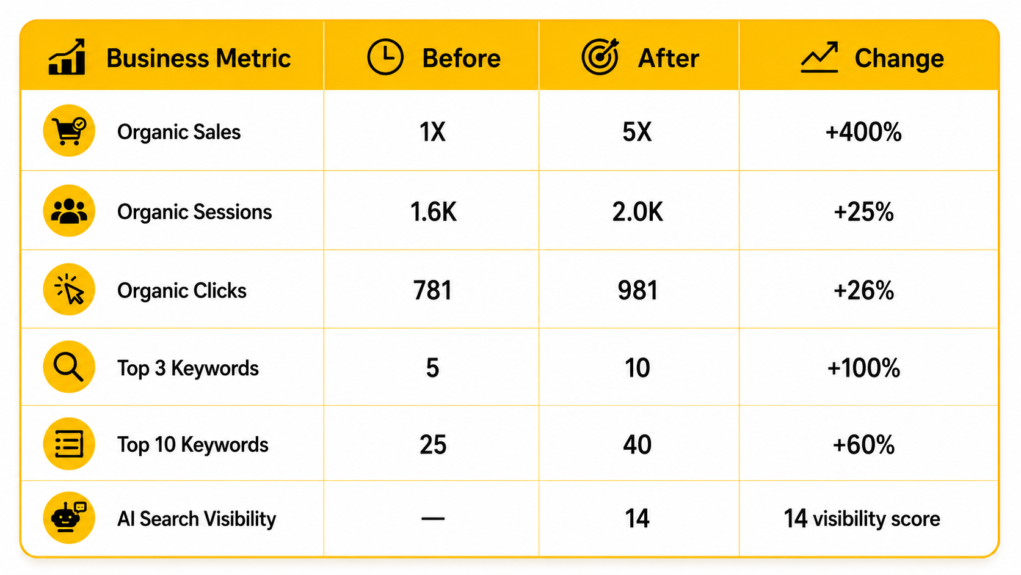
House of Leads combined technical SEO, intent-led content, on-page improvements, internal linking and measurable authority building to improve organic discovery for a client website. According to the campaign evidence prepared for this case study, the work contributed to stronger Google rankings, improved visibility in AI-powered search and 5X more organic sales during the measured period. The result should be published together with the exact baseline, dates and analytics screenshots so readers can verify what “5X” means.
Key Takeaways
- The campaign connected SEO activity to a business outcome — organic sales — rather than reporting only keyword positions.
- The strategy prioritized high-intent pages and supporting content instead of creating high volumes of disconnected blogs.
- Technical SEO and internal linking ensured strong content could actually be discovered and understood.
- AI-search visibility was monitored as an additional discovery channel, while Google rankings and conversion data remained core KPIs.
- The most persuasive part of this case study should be the evidence: dates, screenshots, queries and attribution methodology.
The Business Problem: Visibility Was Not Turning into Enough Organic Revenue
Many businesses reach a point where SEO appears active but the commercial impact remains unclear. Keywords may move. Blogs may be published. Impressions may rise. Yet the management team still cannot answer a simple question: is organic search helping the business sell more?
For this campaign, House of Leads treated that gap as the central problem. The objective was not simply to increase the number of ranking keywords. It was to improve the quality of organic discovery around searches that could lead a prospect toward a relevant product, category or buying decision.
The Outcome We Measured
Why We Did Not Start by Publishing More Blogs
Publishing more content is useful only when the website has a clear search architecture. Before scaling content, we first looked at which pages were supposed to rank, which pages were competing with each other, and where the customer journey broke between discovery and conversion.
- Which commercial pages should own the highest-intent keywords?
- Which questions should be answered by supporting blogs instead?
- Where were multiple pages targeting the same or nearly identical intent?
- Which valuable pages had weak internal links or no supporting content?
- Which pages had impressions but poor clicks, engagement or conversion?
- Which proof points could make the business more trustworthy to both prospects and search systems?
1. Technical SEO Created a Cleaner Foundation
Technical issues can prevent good content from reaching its potential. The campaign therefore included the core checks needed to keep important pages discoverable and understandable.
- Indexability and crawl checks for important commercial and editorial pages.
- Canonical and redirect review to reduce duplicate or conflicting URLs.
- XML sitemap review and submission.
- Page-title, heading and metadata improvements.
- Mobile and page-experience checks.
- Internal-link review to reduce orphaned or weakly connected pages.
2. We Mapped Keywords to the Buying Journey
A high-volume keyword is not automatically a valuable keyword. We grouped queries by what the searcher appeared to be trying to accomplish and assigned each intent to the correct type of page.
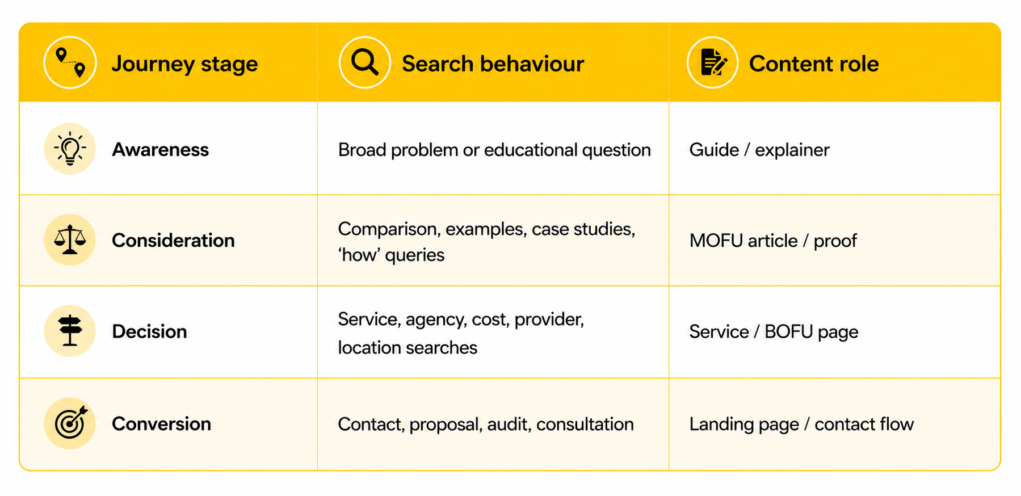
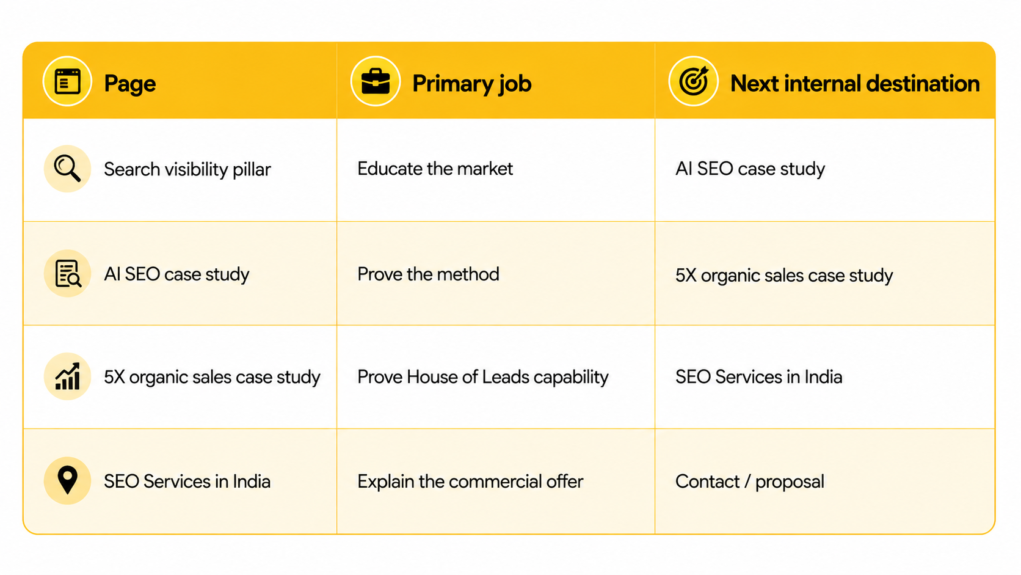
This reduced the temptation to use “SEO company in India” as the primary keyword on multiple case studies. Transactional terms belong primarily to the service page; case studies should capture proof-oriented searches such as “SEO case study India” and then pass users to the service page through internal links.
3. We Built Content Around Questions That Influence Decisions
Strong SEO content does more than attract traffic. It removes uncertainty. We therefore planned content around the questions a potential customer asks before choosing a product or service. This included informational guides, comparison content, proof-led case studies and practical decision content.
The structure also supports AI-assisted search because conversational queries frequently combine several dimensions at once — for example, a user may ask for an approach, a comparison and evidence in the same prompt. Pages that answer those dimensions clearly have a better chance of being useful retrieval sources, although no AI citation can be guaranteed.
4. Internal Linking Turned Individual Pages into a Funnel
Internal linking was used to connect education, evidence and conversion. Instead of placing generic “read more” links, anchor text explained what the destination page would help the reader do next.
5. We Strengthened Evidence and E-E-A-T Signals
Case studies become far more persuasive when the reader can see what happened. Google’s people-first content guidance also emphasizes original information, clear sourcing and first-hand experience. For that reason, campaign evidence should be part of the page, not stored only in an internal report.
- Search Console charts showing the same date ranges used in the narrative.
- Rank-tracking screenshots with the query and date visible.
- GA4 or ecommerce screenshots supporting organic sales claims.
- A short “How we measured this result” section.
- Named House of Leads reviewer/author with relevant expertise.
- Clear disclosure where client identity or commercially sensitive figures are anonymized.
6. We Expanded Measurement Beyond Rankings
Rankings matter, but they are not the only measure of search performance. In 2026, House of Leads recommends tracking a broader visibility and revenue scorecard.
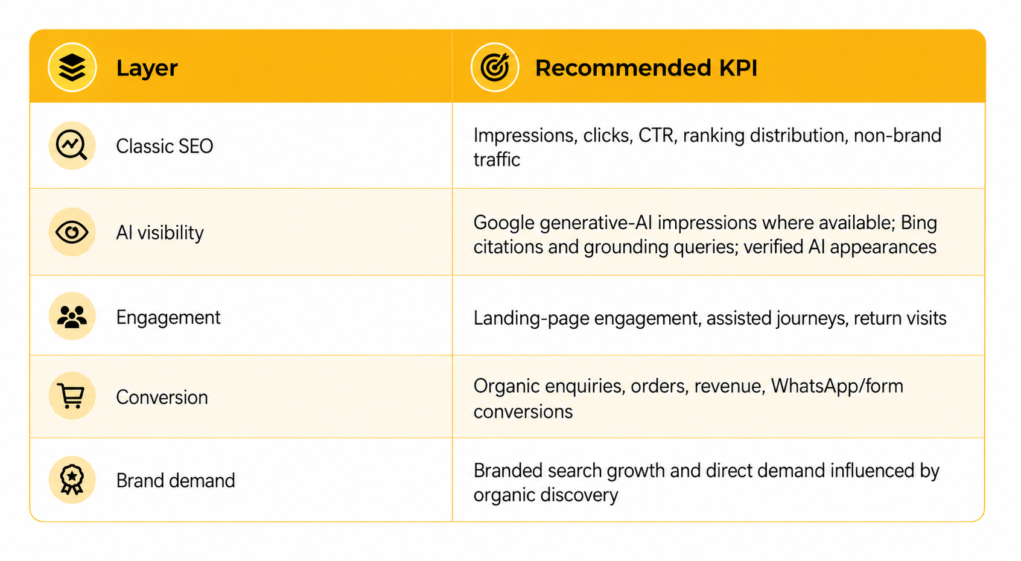
Google introduced dedicated generative-AI performance reporting in Search Console in June 2026 for a subset of sites. Bing Webmaster Tools also provides AI Performance insights such as citation counts, cited pages and grounding queries. These reports make AI visibility more measurable than it was previously.
Where AI Search Fits into the Strategy
AI search should not be treated as a replacement for SEO. Google states that its generative AI features rely on core Search ranking and quality systems. OpenAI states that websites can appear in ChatGPT search when they are publicly accessible and eligible for retrieval, but placement is not guaranteed.
- Keep high-value pages indexable and technically accessible.
- Allow OAI-SearchBot if you want content eligible for ChatGPT search summaries and snippets.
- Use specific, original information rather than generic commodity text.
- Support claims with evidence that can be checked.
- Use tables, definitions, short answers and explanatory headings when they improve clarity.
- Update content when facts or outcomes genuinely change.
Why the 5X Organic Sales Result Matters
A business does not invest in SEO merely to own a spreadsheet full of keywords. The reason to improve search visibility is to create more opportunities for the right people to discover the business and take action. That is why this case study should lead with a verified commercial result and then show how the search work contributed to it.
The strongest published version will clearly separate correlation from attribution. If the business was also running paid media, discounts, influencer campaigns or other promotions during the same period, say so. If “organic sales” is defined by last-click organic attribution in analytics, state that definition. Transparency increases trust and makes the case study more useful.
What Made the Strategy Work
- A clear page-to-keyword map reduced internal competition.
- Commercial pages were supported by educational and proof-led content.
- Technical SEO ensured valuable pages could be crawled, indexed and understood.
- Internal links created a logical path from information to evaluation to conversion.
- First-party evidence made performance claims more credible.
- Reporting connected visibility metrics to leads and sales.
Is This Approach Right for Your Business?
This framework is most useful when your website already has a real product or service, but organic growth has become inconsistent, highly dependent on a few keywords or difficult to connect with revenue. It is also relevant when competitors are beginning to appear more frequently in AI-generated answers and your brand lacks structured, evidence-backed content.
House of Leads SEO Services: From Rankings to Revenue
House of Leads provides SEO services across technical optimization, keyword and intent mapping, content strategy, on-page improvements, internal linking, authority building and performance reporting. Our goal is to make organic visibility commercially useful — not simply bigger.
Read the supporting case study: How AI-Powered SEO Helped a Luxury Saree Brand Earn #1 Google Rankings and Visibility in AI Search
Explore the service: SEO Services in India
Frequently Asked Questions
An SEO case study documents the starting problem, the strategy used, the period measured and the resulting changes in search visibility, traffic, leads or sales. A credible case study includes evidence and methodology.
In this case study, the phrase should refer only to the exact metric verified in analytics or ecommerce records. Before publishing, House of Leads should state the baseline, final value, date range and attribution definition.
Strong SEO can improve a site’s eligibility and usefulness for AI-assisted search because major AI search experiences rely on web retrieval and search indexes. However, no agency can guarantee a specific AI citation or placement.
Track verified appearances, Google generative-AI performance where available, Bing AI citations and grounding queries, ChatGPT referral traffic, and the leads or sales that follow from those discovery paths.
Usually not as the primary keyword if a dedicated service page already targets that transactional query. A case study should target proof-oriented intent and internally link to the commercial service page.
Businesses can contact House of Leads for an SEO review or proposal covering technical issues, keyword opportunities, content gaps, internal linking and organic growth priorities.
A ranking report can tell you where your pages appear. A growth review should also tell you whether those rankings are attracting qualified visitors and producing business results. House of Leads can review your current SEO foundation, content funnel and AI-search readiness, then prioritize the changes most likely to improve discoverability and conversion.
CTA: Request a Free SEO & AI Visibility Review → Contact House of Leads
Editorial References

Article by
Anuj Poddar
Co-Founder | Content Marketer and Strategist
Anuj is the co-founder of House of Leads, a company dedicated to organic social media marketing that helps businesses grow sustainably — without relying on paid ads or boosted posts. Recognized with the New Gen Icon award at the MSME Honours, Anuj has built a reputation for driving real, measurable results through purely organic strategies.
Under his leadership, House of Leads has produced hundreds of viral reels that have generated thousands of enquiries, translating into actual sales for clients across industries. Beyond digital engagement, his campaigns have also driven tangible increases in store footfall, proving that organic content can move people from screens to storefronts.
Anuj’s approach starts with a deep dive into the target audience, followed by a thorough study of the product or service itself. This research-driven foundation allows him to craft genuinely relatable content that resonates — turning everyday viewers into loyal customers, and brands into recognizable names, all without spending a rupee on ads.