
Content Marketing Strategy for Businesses in India: How to Build Search Visibility, Authority and Qualified Leads
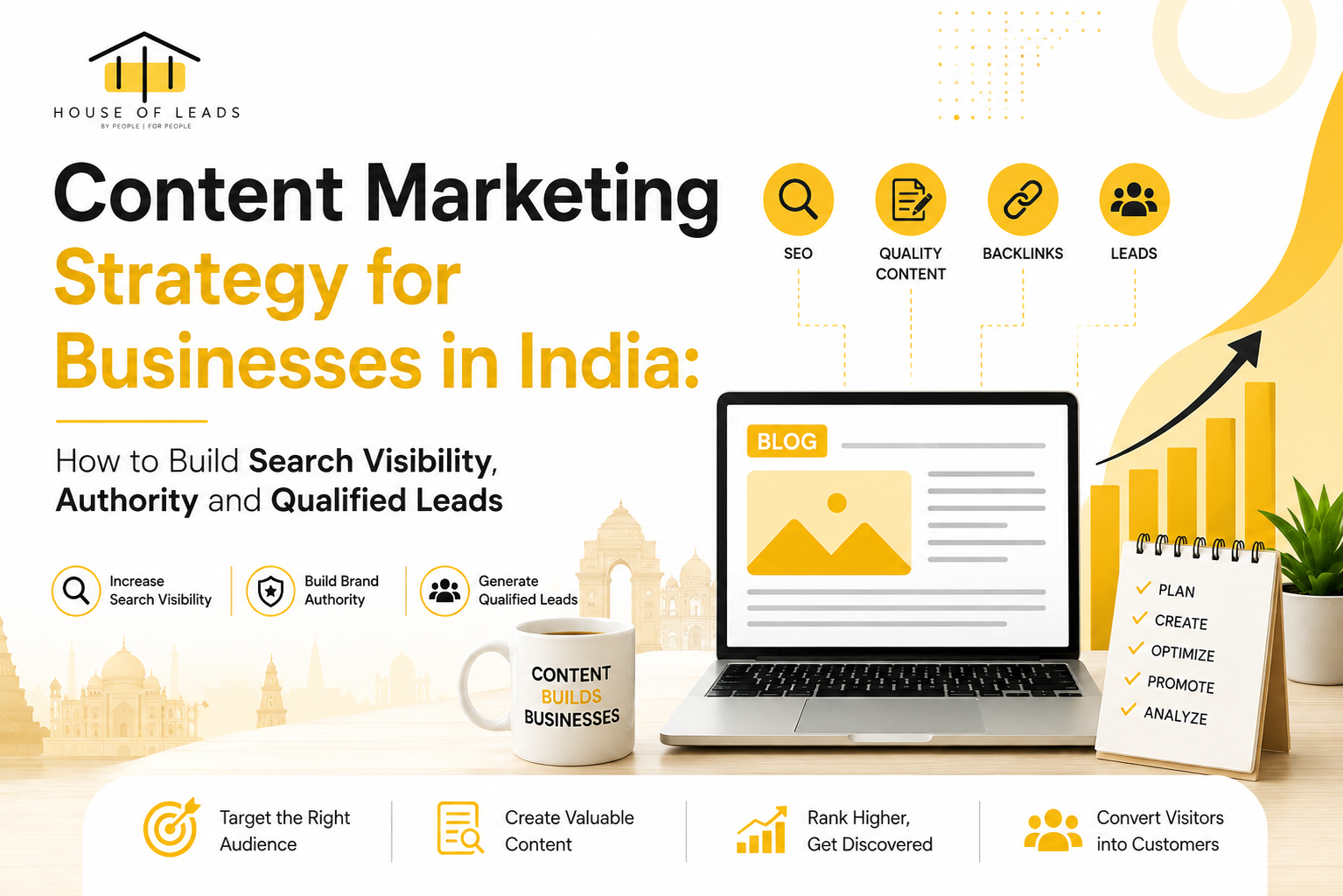
A strong content marketing strategy connects business goals, customer questions, search intent, subject-matter expertise, distribution and measurement. In 2026, businesses should plan content not only for traditional Google rankings but also for AI-assisted discovery. The most effective approach is to create original, useful content clusters that answer specific questions, prove expertise with first-party evidence, link naturally to commercial pages and measure qualified leads — not just page views.
Key Takeaways
Start with business goals and customer questions, not a target word count or publishing quota.
- Give every page one clear search intent so blogs do not compete with service pages.
- Build topic clusters that connect TOFU education, MOFU proof and BOFU conversion content.
- Original evidence, examples, screenshots and expert input make content more useful to people and more referenceable in AI search.
- Measure content by visibility, qualified engagement, assisted journeys and leads — not traffic alone.
What Is a Content Marketing Strategy?
A content marketing strategy is the plan that determines what information a business will create, who it is for, which customer problem it addresses, how it will be distributed and how success will be measured. It is broader than a blog calendar. A calendar tells you when something will be published. A strategy explains why that content should exist and what role it plays in the customer journey.
For businesses in India, this matters because customers now discover brands through several connected surfaces: Google Search, AI Overviews, AI Mode, ChatGPT search, Microsoft Copilot, social platforms, video and recommendations. The content itself needs to remain useful regardless of which surface introduces the customer to the brand.
Why Content Strategy Matters More in AI-Powered Search
Search is becoming more conversational. People increasingly ask multi-part questions instead of typing a short keyword and opening ten blue links. That does not make SEO obsolete. Google’s 2026 guidance says SEO remains relevant for its generative AI features because those experiences are rooted in core Search ranking and quality systems.
The practical implication is simple: businesses do not need a separate library of “AI-only” articles. They need clearer, more original and more complete content that search and AI systems can retrieve when it is relevant.
- Answer the main question early.
- Use clear headings that describe what each section explains.
- Add original examples and first-party data where possible.
- Cite primary sources for external claims and statistics.
- Use tables and lists when they make comparison or extraction easier.
- Keep commercial claims specific and verifiable.
- Make important pages crawlable, indexable and internally connected.
The 8-Part Content Marketing Strategy Framework
House of Leads recommends building content strategy as an operating system rather than a list of topics. The eight parts below create a repeatable structure that can support SEO, GEO, social distribution and lead generation at the same time.
1. Define the Business Outcome First
Every content program should begin with a business outcome. “Publish four blogs a month” is an activity, not an outcome. A useful objective is specific enough to guide topic selection and measurement.
Weak objective | Stronger objective |
Increase blog traffic | Increase non-brand organic visits to service-supporting content and generate qualified consultation enquiries |
Post more on Instagram | Use educational and proof-led posts to grow relevant reach and drive profile visits, DMs and site sessions |
Rank for more keywords | Increase Top 10 visibility for commercially relevant topic clusters without cannibalizing service pages |
2. Map the Audience by Questions, Not Only Demographics
Age, location and industry are useful, but search behaviour is often more actionable. Build a question map showing what the customer wants to know at each stage.
Stage | Typical question | Content format |
TOFU — awareness | How does this work? What should I do? | Guide, checklist, explainer, glossary |
MOFU — consideration | Does this work for a business like mine? | Case study, comparison, framework, benchmark |
BOFU — decision | Which provider should I choose? What will it cost? | Service page, pricing guide, agency comparison, proof page |
This funnel structure is especially useful for House of Leads because an informational article can educate without competing with a service page. The article should then link the user to proof and eventually to the commercial destination.
3. Create a Page-to-Keyword Map Before Writing
Keyword research should decide which page deserves to rank for which intent. If the same primary keyword appears across a service page, three case studies and five blogs, search engines receive mixed signals and users receive repetitive content.
- Assign high-commercial keywords such as “content marketing services in India” primarily to the service page.
- Use “content marketing strategy” for the educational pillar.
- Use “content marketing case study” for proof-led MOFU pages.
- Use cost, comparison and agency-evaluation queries for BOFU content.
- Use supporting long-tail questions to expand the topic without duplicating the same intent.
4. Build Topic Clusters, Not Random Blog Lists
A topic cluster is a connected group of pages covering one subject from different angles. The pages link to each other and collectively answer the questions a customer may ask as they move toward a decision.
Cluster layer | Example for Content Marketing | Purpose |
Pillar | Content Marketing Strategy for Businesses in India | Own the broad educational framework |
Supporting TOFU | Content calendar, topic research, content distribution, content measurement | Answer narrower questions |
MOFU proof | How content improved rankings and impressions for a saree brand | Demonstrate real execution |
BOFU proof | How House of Leads achieved #1 and Top 3 rankings with content | Build agency confidence |
Commercial | Content Marketing Services in India | Convert purchase-ready visitors |
5. Make Every Important Page “Answer-First”
Long introductions that delay the answer are frustrating for users and make key information harder to locate. For important educational pages, answer the central question in the opening section, then expand with context, steps, examples and evidence.
Instead of | Use |
“In today’s fast-paced digital world, content has become more important than ever…” | “A content marketing strategy connects customer questions with useful content, distribution and measurable business outcomes.” |
A vague H2 such as “The Power of Content” | “How Does Content Marketing Generate Qualified Leads?” |
Unsupported claim: “Content always improves rankings” | Specific explanation + evidence + limitations |
This style is not about writing for robots. It is about respecting the reader’s time. Clear answers also make it easier for search and AI systems to identify the relevant passage when a user asks a specific question.
6. Add Information Competitors Cannot Easily Copy
Generic advice has become abundant. The strongest way to differentiate content is to publish information that comes from your own work. Google explicitly encourages original information, research and analysis. Bing recommends examples, data and cited sources to strengthen AI-reference potential.
- Campaign screenshots from Search Console, GA4, Instagram Insights or CRM systems.
- Before-and-after metrics with a clear measurement period.
- Mini case studies and mistakes learned during execution.
- Original benchmarks drawn from your client work, with methodology.
- Expert commentary from the person who actually performed or reviewed the work.
- Original charts, process diagrams and checklists.
For House of Leads, this creates a major opportunity. A “Growth Lab” section can turn anonymized campaign data into recurring studies such as Instagram reach benchmarks, SEO visibility trends and content-ranking observations. Even a smaller dataset can be valuable if the methodology is transparent.
7. Plan Distribution Before You Publish
Publishing is only the beginning. Every major article should have a distribution plan that creates additional discovery paths and signals of real audience value.
Core article element | Repurposed asset |
Main problem | 30–45 second Instagram Reel |
Framework or steps | Carousel post |
Result or statistic | Proof post / chart |
FAQ | Instagram Stories / LinkedIn post |
Expert lesson | Founder or strategist video |
Original data | Mini report / outreach asset / PR pitch |
For @houseofleads_, this means every high-value blog should generate several social assets rather than one “new blog” announcement. The social content should reveal one useful insight and then direct interested users to the deeper article.
8. Measure the Full Content Funnel
Content success should be measured in layers. A TOFU guide may not produce a lead on the first session, but it can still introduce a qualified user, earn a citation, improve branded demand or assist a later conversion.
Layer | What to track |
Visibility | Impressions, rankings, cited pages, AI-search visibility, social reach |
Engagement | Clicks, engaged sessions, scroll depth, saves, shares, return visits |
Progression | Clicks from TOFU to MOFU, MOFU to service pages, assisted journeys |
Conversion | Forms, WhatsApp clicks, calls, consultations, ecommerce sales |
Efficiency | Cost per qualified lead, content production cost, revenue influenced |
How to Plan a TOFU → MOFU → BOFU Content Funnel
The funnel works best when the articles are designed as a sequence rather than published as unrelated topics.
Funnel stage | What the reader needs | House of Leads content example | CTA |
TOFU | Understand the problem and approach | Content Marketing Strategy for Businesses in India | Read a real case study |
MOFU | See proof that the approach works | How Content Marketing Improved Rankings and Impressions for a Saree Brand | See House of Leads results |
BOFU | Evaluate the provider | How House of Leads Achieved #1 and Top 3 Search Rankings | Explore content marketing services |
Service | Understand scope and take action | Content Marketing Services in India | Request consultation |
Content Formats That Build Search and AI Visibility
A strong strategy uses different formats for different jobs. Not every topic needs a 2,000-word article.
- Pillar guides for broad, durable subjects.
- Case studies for first-party proof and commercial credibility.
- Comparison pages for decision-stage questions.
- Cost and pricing guides for high-intent evaluation searches.
- Glossaries and direct-answer explainers for recurring definitions.
- Original studies and benchmark reports for citations and links.
- Video and visual explainers for multimodal discovery.
- FAQ sections for user clarity even though Google discontinued FAQ rich results in May 2026.
How to Write Content That Is Easier to Cite in AI Answers
There is no guaranteed “GEO format.” Google explicitly warns against myths suggesting that special AI-only optimization is required. However, content can be made easier to retrieve and verify by improving clarity and evidence.
- Use a descriptive title that matches the actual subject.
- Provide a concise direct answer near the top.
- Break complex ideas into specific headings and complete answers.
- Use original data and clearly explain how it was measured.
- Cite the original source for external statistics.
- Keep names, dates, products and business details consistent across text, images and structured data.
- Use tables for comparisons and lists for steps where appropriate.
- Keep the page accessible to relevant crawlers and eligible for normal indexing.
- Update the content when the underlying information genuinely changes.
A Simple 30-Day Content Marketing Plan
Week | Main activity | Output |
Week 1 | Audit search intent, existing pages, cannibalization and customer questions | Topic map + page-to-keyword map |
Week 2 | Create one pillar and one supporting proof asset | TOFU guide + MOFU case-study draft |
Week 3 | Publish, internally link and repurpose for social | Live article + Reel + carousel + proof post |
Week 4 | Measure indexing, rankings, engagement and assisted conversion | Performance review + update list |
Repeat the process by cluster. Do not start five service categories at once. It is usually more effective to build enough depth around a few core services before expanding into the next area.
Common Content Marketing Mistakes to Avoid
- Publishing only because a calendar says a blog is due.
- Using one primary commercial keyword across many pages.
- Forcing a fixed 1–2% keyword density instead of writing naturally around intent and related concepts.
- Making large statistics or performance claims without original sources.
- Using AI to mass-produce pages without first-party value or careful review.
- Writing broad generic intros while hiding the useful answer halfway down the page.
- Creating content with no internal links or conversion path.
- Measuring traffic while ignoring qualified leads and revenue.
How House of Leads Can Turn Content into a Growth System
House of Leads already offers content strategy, creation, distribution, optimization, link building and reporting. The next step is to make those capabilities visible through connected proof. Educational articles should demonstrate the thinking. Case studies should demonstrate the result. Service pages should explain how a business can engage House of Leads to apply the process.
Existing background article: Why Content Marketing Services Agency Is Important for Businesses in India
Commercial service page: Content Marketing Services in India
Frequently Asked Questions
Define the business outcome and identify the customer questions that influence that outcome. Topic selection and keyword research should follow, not come first.
There is no universal publishing frequency that guarantees rankings. Publish at a pace that allows you to create useful, accurate and differentiated content, then maintain and update it based on performance.
Content marketing plans and distributes useful information to attract, educate and convert an audience. SEO helps search engines discover, understand and rank that content. The strongest programs combine both.
Useful public content can be discovered and cited by AI search systems when it is crawlable, relevant and reliable. OpenAI recommends allowing OAI-SearchBot for eligibility in ChatGPT search summaries and snippets, but placement is not guaranteed.
AI can assist research, ideation and structure, but mass-producing pages without original value can create quality and spam risks. Human expertise, fact checking, first-party evidence and editorial review remain important.
Lead-generating content usually combines education with commercial relevance. Case studies, comparison pages, cost guides, decision checklists and strong service-supporting articles often work well because they address questions close to a buying decision.
Track visibility and engagement, but connect them to progression and conversion metrics such as service-page visits, enquiries, assisted conversions, sales and revenue influenced by organic or social content.
Yes. House of Leads provides content strategy, creation, optimization, distribution, link building and analytics services for businesses seeking stronger organic visibility, authority and lead generation.
Build Content That Does More Than Fill a Calendar
A good content program should make your brand easier to discover, easier to trust and easier to choose. That requires more than publishing volume. It requires a clear content architecture, original evidence, useful answers, distribution and measurement connected to business outcomes.
If your current content brings impressions but few qualified enquiries, House of Leads can audit your existing pages, identify keyword and intent overlap, map new content clusters and build a strategy designed around search visibility, AI-assisted discovery and conversion.
Request a Content Strategy & Visibility Review → Contact House of Leads
Editorial References
- Google: Optimizing your website for generative AI features on Google Search
- Google: Creating helpful, reliable, people-first content
- Google: Guidance on using generative AI content
- Google: AI features and your website
- Bing: AI Performance in Bing Webmaster Tools
- OpenAI: Publishers and Developers FAQ
- House of Leads: Content Marketing Services in India

Article by
Piyush Sethia
Co-Founder | Content Marketer and Strategist
Recognised as the 2026 Tally MSME Business ‘Tech Transformer’ Award winner, Piyush Sethia leverages advanced tech facilities to transform content marketing and writing efficiency. With over a decade of experience, he specializes in data-backed content marketing, AIO, GEO, SEO strategy, and organic growth blueprints. He is also the author of The Clarity of Confusion, showcasing his unique ability of storytelling and simplifyinig complex landscapes into crystal-clear narratives. His expertise lies in converting technical data and deep audience insights into engaging, search-optimized strategies that drive sustainable traffic.