
Key Takeaways
- Content was planned around search intent rather than publishing volume.
- TOFU, MOFU and BOFU topics were connected instead of being published independently.
- Existing category and product pages were supported through contextual internal links.
- Content targeted long-tail questions before competing for broader commercial keywords.
- Existing articles were updated where improving them offered more value than creating another page.
- Search Console data was used to identify impressions, ranking movement and new opportunities.
- Content helped the brand build authority around sarees, fabrics, styling, occasions and buying decisions rather than individual keywords alone.
The Challenge: Good Products, Limited Search Discovery
Fashion and ethnic-wear ecommerce is extremely competitive.
A customer may start with a broad search such as:
best saree for wedding
and later search:
tissue silk saree
then:
how to identify pure tissue silk
and finally:
buy tissue silk saree online
These searches represent different stages of the same customer journey.
The saree brand had commercial pages capable of serving buyers who already knew what they wanted. The missing piece was informational content capable of attracting them before they reached the final purchase stage.
That created several problems:
- insufficient visibility for long-tail queries;
- commercial pages carrying most of the SEO burden;
- weak topical connections between blogs and collections;
- limited coverage of customer questions;
- fewer entry points from organic search;
- competitors answering queries the brand should have owned.
Simply adding keywords to product pages would not solve those issues.
The website needed content architecture.
What Was the Content Marketing Strategy?
The strategy was built around one principle:
Every article needed a role in the customer journey.
Instead of treating the blog as a publishing calendar, topics were mapped into connected search clusters.
1. We Started With Search Intent
Keywords were divided according to what the searcher was actually trying to accomplish.
For example:
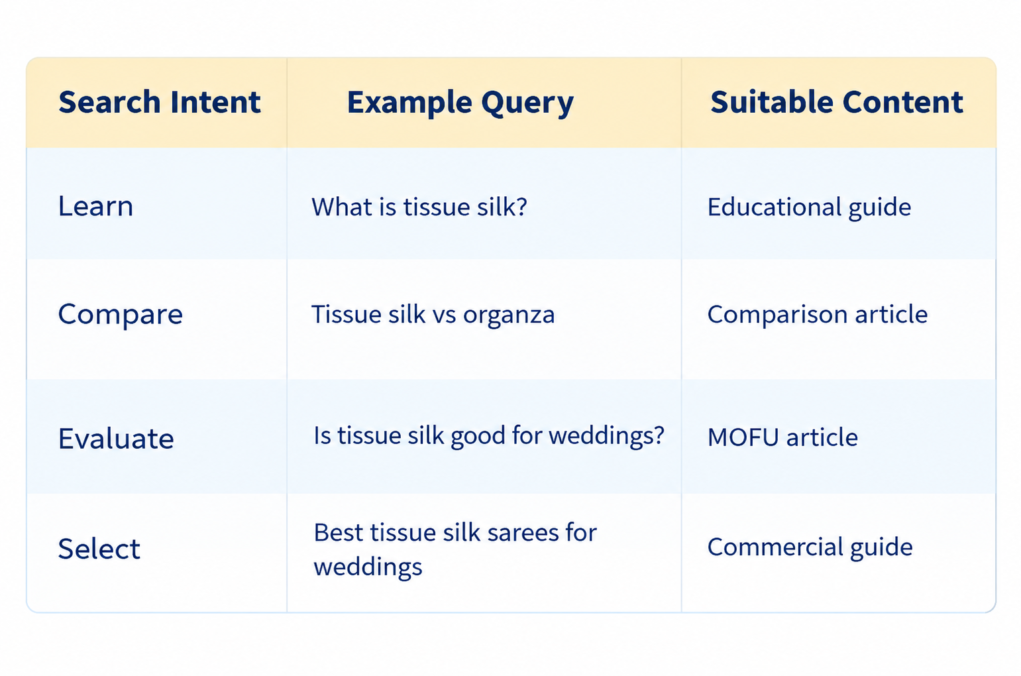
This prevented every page from targeting the same commercial keyword.
More importantly, it allowed the website to participate across several stages of discovery.
2. We Built Topic Clusters Around Real Saree Questions
Instead of producing unrelated fashion blogs, content was grouped around commercially useful themes such as:
- saree fabrics;
- silk varieties;
- Banarasi weaving;
- wedding sarees;
- festive sarees;
- saree styling;
- care and maintenance;
- authenticity and craftsmanship;
- colour and occasion selection;
- buying guides.
A pillar article could answer the broad question while supporting articles handled narrower searches.
For example:
Tissue Silk Saree Guide
could connect with:
- Tissue Silk vs Organza
- How to Identify Genuine Tissue Silk
- Best Occasions to Wear Tissue Silk
- Tissue Silk Saree Care Guide
- Tissue Silk Sarees for Weddings
Those articles could then direct commercially ready readers toward the relevant collection.
The website therefore stopped depending on one page for one keyword.
It began building topical depth.
3. We Focused on Questions Customers Actually Ask
Traditional SEO often starts with keywords.
Effective content strategy starts one step earlier:
Why is somebody searching for this?
Examples included:
- Which saree fabric is best for summer?
- What is the difference between Banarasi silk and tissue silk?
- How can I identify an authentic Banarasi saree?
- Which saree is appropriate for a wedding guest?
- How should silk sarees be stored?
- Are lightweight silk sarees suitable for long events?
These questions create natural opportunities for long-tail SEO and answer-focused content.
They also make articles more suitable for search experiences where users increasingly ask full questions rather than entering two- or three-word keywords.
4. We Made the Content Easier to Understand and Retrieve
The content structure was standardized.
Important articles included:
- a clear H1;
- a short direct answer near the beginning;
- Key Takeaways;
- descriptive H2 and H3 headings;
- question-led sections;
- comparison tables;
- bullet points;
- practical examples;
- FAQs;
- relevant internal links;
- sources where external facts were used.
This structure benefits human readers first.
It also makes individual passages more self-contained, which can help search and AI systems understand what part of a page answers a particular question.
5. We Connected Blogs With Commercial Pages
Publishing informational content without internal linking leaves significant SEO value unused.
Relevant articles were therefore connected to:
- saree collection pages;
- individual category pages;
- related educational articles;
- supporting guides;
- other suitable commercial destinations.
Consider a reader searching:
Which saree is best for a summer wedding?
The article can answer the question first.
Then, when relevant, it can naturally introduce suitable lightweight collections.
The reader receives useful information rather than an immediate sales pitch, while the commercial page receives contextual internal-link support.
That is where content marketing begins contributing to both visibility and revenue opportunity.
What Changed After the Content Strategy Was Implemented?
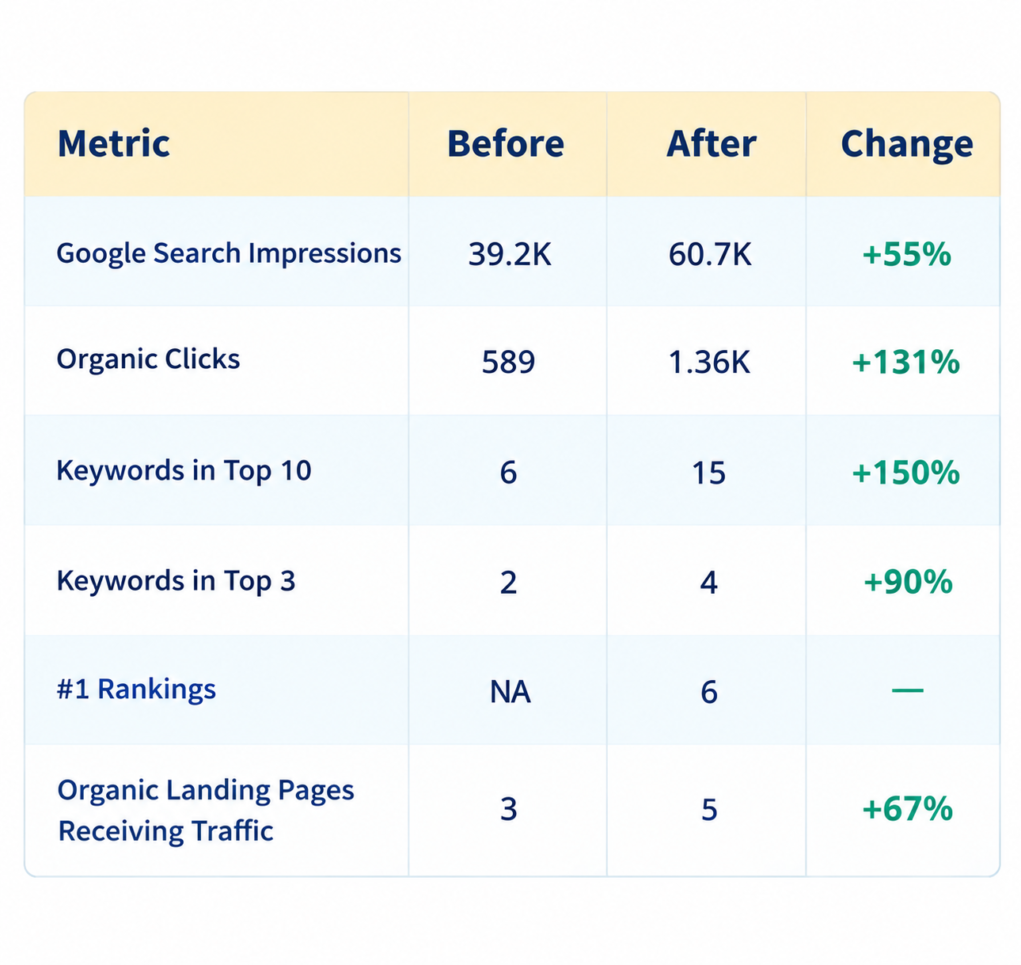
The strongest case studies do not stop at saying that “rankings improved.”
They show what changed.
Campaign Performance
Which Keywords Improved?
Add 5–10 of the strongest verified examples.
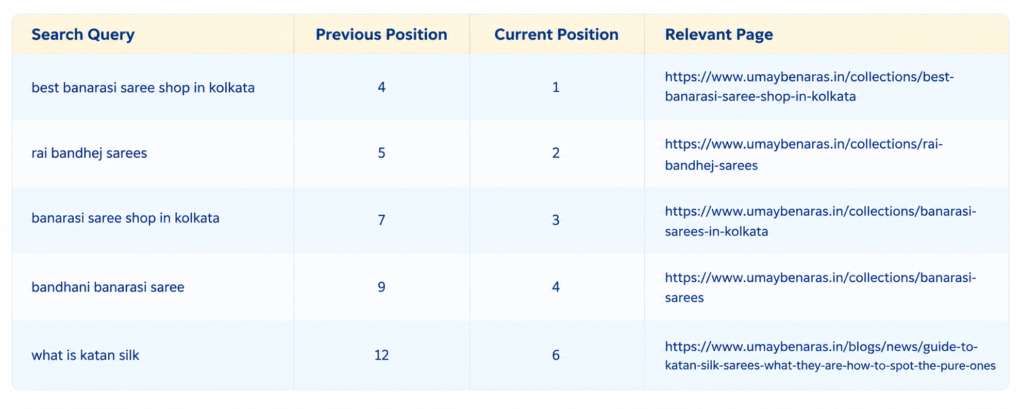
This section is particularly important.
A statement such as “rankings improved” is marketing language.
A table showing:
Keyword → Before → After → URL → Date
is evidence.
Why Did Search Impressions Grow?
Growth in search impressions usually does not come from one isolated change.
In this campaign, the content strategy expanded the number of relevant searches for which the website could reasonably appear.
Instead of depending only on product and collection queries, the brand could address searches relating to:
fabric + occasion + problem + comparison + styling + care + purchase consideration
That produced more search entry points.
A customer did not need to know the brand’s name to discover it.
That is particularly valuable for ecommerce businesses trying to expand beyond branded traffic.
Why Content Depth Matters More Than Publishing Volume
Publishing four weak articles every week is not necessarily better than publishing one article that genuinely answers the query.
For this campaign, content quality meant asking:
- Does this article answer something the customer actually needs?
- Does another page already answer it?
- Can we provide greater depth?
- Can we demonstrate experience?
- Is there a natural commercial connection?
- Can the article be updated as search behaviour changes?
- Does it deserve to exist independently?
That prevented unnecessary content duplication.
It also made the blog library easier to expand logically.
What This Case Study Teaches Ecommerce Brands
The biggest lesson is simple:
Content marketing should create search pathways, not just blog posts.
For an ecommerce business, an effective pathway may look like:
Educational Guide → Comparison → Buying Guide → Collection → Product
Different visitors can enter at different points.
The objective is to ensure the website has useful information wherever an interested customer enters the journey.
What About AI Search Visibility?
Search discovery is becoming broader than conventional blue links.
Content can now be encountered through traditional Google results, AI-generated search experiences and other answer-driven interfaces.
That makes clarity and evidence increasingly valuable.
The strongest content is usually content that can clearly establish:
- what something is;
- how it works;
- when it is useful;
- how two choices differ;
- what evidence supports a claim;
- what action the reader should take next.
For House of Leads, the objective is therefore not to create separate “AI content.”
It is to create better web content that remains useful across search experiences.
How House of Leads Approached the Campaign
The campaign combined:
- audience and intent research;
- keyword mapping;
- content-gap analysis;
- TOFU–MOFU–BOFU planning;
- SEO-focused content creation;
- on-page optimization;
- internal linking;
- existing-content updates;
- performance monitoring;
- continued topic expansion based on data.
This matters because content marketing rarely delivers its strongest results when separated from SEO.
Content creates the useful asset.
SEO helps the right audience discover it.
Analytics shows what should happen next.
Conclusion
The saree brand did not need more content for the sake of publishing.
It needed the right content connected in the right way.
By moving from isolated blog posts to intent-driven topic clusters, the website created more opportunities to appear for relevant searches, support commercial pages and engage customers before they were ready to purchase.
The most useful result was not merely publishing more pages.
It was increasing the number of meaningful ways potential customers could discover the brand.
For businesses facing the same challenge, House of Leads builds content strategies around search demand, customer intent, commercial priorities and measurable organic performance.
Explore House of Leads’ Content Marketing Services to understand how a similar strategy can be developed for your business.
Frequently Asked Questions
A content marketing case study explains the original business challenge, strategy implemented and measurable results generated through content. Strong case studies include evidence such as impressions, clicks, rankings, conversions and analytics screenshots.
Content can support rankings when it satisfies relevant search intent, provides useful information and is supported by strong technical SEO, internal linking and overall site quality. Publishing content alone does not guarantee rankings.
Useful content expands the range of searches for which a website can become relevant. Topic clusters can capture informational, comparison and commercial-intent searches across different stages of the customer journey.
There is no universal timeframe. Results depend on competition, website authority, technical health, topic selection, content quality and the strength of competing pages.
Yes. Ecommerce businesses can use guides, comparisons, FAQs, styling advice and buying content to attract customers before they reach product-level searches.
Useful metrics include impressions, clicks, non-branded traffic, ranking keywords, Top 10 and Top 3 positions, organic conversions, assisted conversions and revenue where attribution is available.
Clear, useful, well-structured and evidence-backed content can make information easier for search and AI systems to interpret and reference. AI visibility should be tracked separately rather than assumed from conventional rankings.
Yes, when the link genuinely helps the reader. Informational content should naturally connect users to suitable collections, categories or products rather than inserting promotional links without context.

Article by
Piyush Sethia
Co-Founder | Content Marketer and Strategist
Recognised as the 2026 Tally MSME Business ‘Tech Transformer’ Award winner, Piyush Sethia leverages advanced tech facilities to transform content marketing and writing efficiency. With over a decade of experience, he specializes in data-backed content marketing, AIO, GEO, SEO strategy, and organic growth blueprints. He is also the author of The Clarity of Confusion, showcasing his unique ability of storytelling and simplifyinig complex landscapes into crystal-clear narratives. His expertise lies in converting technical data and deep audience insights into engaging, search-optimized strategies that drive sustainable traffic.