
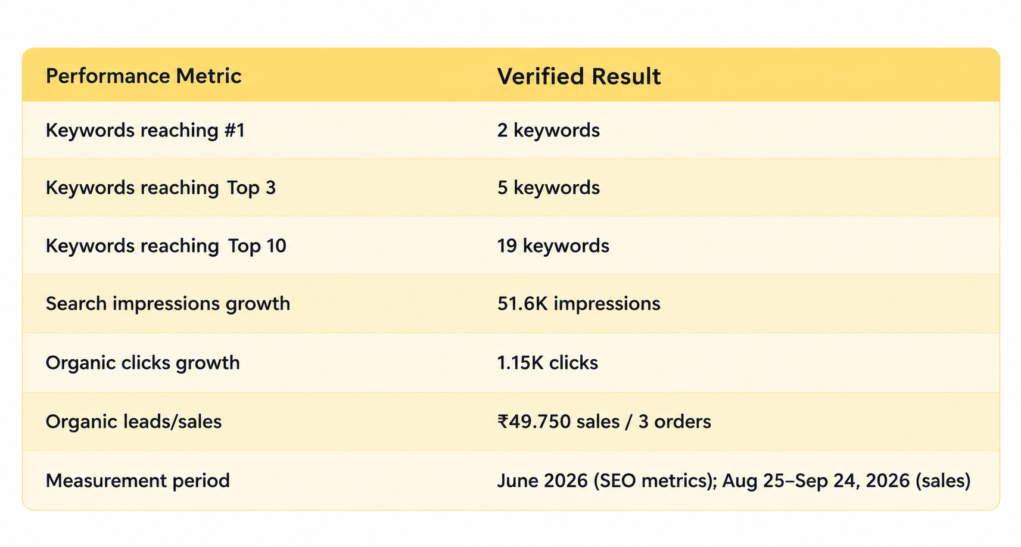
Results at a Glance
Key Takeaways
- House of Leads starts with business goals and search intent, not blog volume.
- Keywords are assigned to specific pages to reduce unnecessary cannibalization.
- Content is organized into TOFU, MOFU and BOFU journeys.
- Articles support commercial service/category pages through contextual internal linking.
- Existing content is updated instead of creating unnecessary duplicate pages.
- First-party performance data guides future content decisions.
- Rankings are evaluated alongside traffic, enquiries, conversions and revenue.
- Content is structured so answers are clear for both human readers and modern search experiences.
Why Most Content Marketing Campaigns Struggle
A common content plan looks something like this:
Week 1: Publish blog.
Week 2: Publish another blog.
Week 3: Publish another blog.
Week 4: Send ranking report.
The problem is that publishing activity is being mistaken for strategy.
A website can publish 100 articles and still struggle organically if:
- topics are disconnected;
- search intent is misunderstood;
- multiple pages compete for the same keyword;
- commercial pages receive no content support;
- articles simply repeat information available elsewhere;
- internal linking is weak;
- existing content is never updated;
- results are measured only in word counts and rankings.
House of Leads approaches the problem differently.
The House of Leads Content-to-Ranking Framework
The process can be understood in seven stages.
Stage 1: Find Commercially Relevant Search Demand
Keyword research does not begin with:
Which keywords have the highest volume?
It begins with:
Which questions and searches can eventually matter to this business?
Searches are grouped according to:
- relevance;
- intent;
- competition;
- customer journey stage;
- commercial relationship;
- existing website authority;
- realistic ranking opportunity.
A lower-volume query with strong business relevance can be more valuable than a high-volume term with no connection to the company’s offering.
Stage 2: Map One Intent to the Right Page
One of the easiest ways to weaken an SEO strategy is allowing several pages to target essentially the same query.
For example, a business may have:
- a service page targeting “content marketing services India”;
- an article targeting the same term;
- a case study targeting the same term;
- another city page repeating similar content.
Instead of strengthening the topic, those pages can create ambiguity about which URL should represent the query.
The House of Leads model assigns clear jobs:
Pillar Page → broad educational intent
Supporting Blog → specific informational query
Case Study → evidence and consideration
Service Page → commercial intent
Contact Page → conversion
That creates a cleaner search architecture.
Stage 3: Build TOFU, MOFU and BOFU Content
Customers rarely move directly from:
“I have a problem”
to:
“Hire this agency.”
Content needs to support the steps between them.
TOFU — Discovery
Examples:
- What is content marketing?
- How does content marketing improve SEO?
- SEO vs AEO vs GEO
- How to build organic search visibility
MOFU — Evaluation
Examples:
- Content marketing case study
- How a saree brand increased search impressions
- How topic clusters improve ecommerce SEO
- Content strategy examples
BOFU — Decision
Examples:
- Content marketing agency case study
- Content marketing services cost
- Agency vs in-house content marketing
- House of Leads results
This creates a journey rather than a random blog archive.
Stage 4: Create Content Worth Ranking
There is little strategic value in rewriting the first five pages already ranking on Google.
A useful article needs a reason to exist.
Depending on the topic, that may include:
- original client data;
- campaign screenshots;
- expert explanation;
- before/after analysis;
- comparison tables;
- step-by-step frameworks;
- original examples;
- lessons learned;
- mistakes encountered;
- local/business context;
- answers competitors have missed.
This is particularly important as search becomes more answer-driven.
Generic information is easy to reproduce.
Experience and proprietary evidence are much harder to replace.
Stage 5: Strengthen Commercial Pages Through Internal Links
Content should not become a separate section of the website that users visit and leave.
Informational pages need logical connections to relevant commercial pages.
For example:
Content Marketing Strategy Guide
↓
Saree Brand Content Marketing Case Study
↓
House of Leads Results Case Study
↓
Content Marketing Services
↓
Request a Strategy Discussion
That structure helps users move naturally from learning to evaluation.
It also establishes relationships between informational and commercial pages.
Stage 6: Optimize What Already Exists
Content marketing is not exclusively a publishing exercise.
Sometimes the most valuable action is updating a page that already has:
- impressions;
- backlinks;
- rankings between positions 4–20;
- historical authority;
- established internal links.
An existing article may need:
- stronger introduction;
- better search-intent alignment;
- additional examples;
- updated statistics;
- clearer headings;
- new internal links;
- better images;
- comparison tables;
- improved CTA;
- consolidation with another weak article.
This can be more efficient than constantly creating new URLs.
Stage 7: Use Performance Data to Decide What Comes Next
The content calendar should change when the data changes.
House of Leads evaluates signals such as:
- impressions;
- clicks;
- CTR;
- query growth;
- ranking position;
- non-branded traffic;
- Top 3 rankings;
- Top 10 rankings;
- organic landing pages;
- leads;
- sales;
- AI-search citation data where available.
Suppose an article begins generating significant impressions around:
“best saree for summer wedding”
but it ranks at position 12.
That is not simply a report metric.
It is an optimization opportunity.
The page may need greater depth, stronger internal links, better alignment with the query or supporting content.
Data therefore becomes the next content brief.
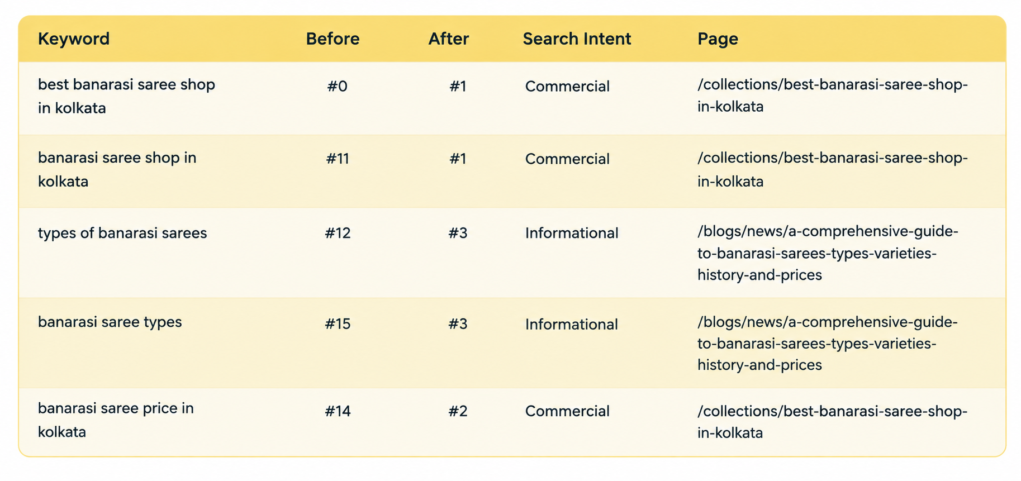
What Did the Rankings Look Like?
This section should contain actual evidence rather than promotional copy.
Verified Search Ranking Examples
Why #1 Rankings Alone Are Not Enough
A keyword can rank first and still produce little commercial value.
That is why rankings need context.
Ask:
- Does the query have relevant intent?
- Is the page attracting the correct audience?
- Is organic traffic increasing?
- Are readers moving deeper into the website?
- Are enquiries increasing?
- Is the content supporting revenue?
- Is the result sustainable?
House of Leads therefore treats rankings as one performance layer rather than the final objective.
The more useful chain is:
Visibility → Relevant Traffic → Engagement → Enquiry → Revenue
How This Strategy Supports AEO and GEO
Search behaviour is becoming more conversational.
Users increasingly ask questions such as:
Which content marketing strategy works for ecommerce?
How can a small business improve organic visibility?
What is the difference between SEO, AEO and GEO?
Which content marketing agency has ecommerce experience?
Content that provides clear, self-contained and evidence-backed answers is better suited to this environment than content written only around keyword repetition.
For that reason, House of Leads articles increasingly emphasize:
- direct answers;
- question-led headings;
- concise definitions;
- tables;
- original data;
- clear entities;
- examples;
- transparent methodology;
- updated information;
- attributable claims.
The goal is not to “write for AI.”
The goal is to make information easy to understand, verify and use, regardless of whether discovery begins through traditional search or an AI-assisted interface.
What Makes House of Leads’ Content Marketing Different?
Content creation is only one component.
The broader approach combines:
Search Strategy
Understanding demand, intent, competition and ranking opportunities.
Content Planning
Building topic clusters and full-funnel journeys rather than isolated articles.
SEO Optimization
Optimizing page structure, titles, headings, entities, links and supporting on-page signals.
Content Creation
Producing useful articles, guides, case studies and commercial assets.
Internal Linking
Connecting authority-building pages with commercially valuable destinations.
Content Updating
Refreshing existing assets as data, markets and search behaviour change.
Measurement
Monitoring whether content is creating meaningful organic outcomes.
House of Leads already offers these activities across content planning, creation, optimization, distribution and analytics; this case study should connect those capabilities directly with verified outcomes rather than repeating the service-page copy.
When Should a Business Consider Content Marketing Services?
A structured content program may be particularly useful when:
- competitors dominate informational searches;
- the website depends heavily on paid acquisition;
- service or product pages have little supporting content;
- organic traffic is stagnant;
- the company has expertise but does not communicate it online;
- many articles exist but generate little traffic;
- rankings are concentrated around branded keywords;
- the business wants greater visibility across traditional and AI-assisted search experiences.
The strategy, however, should begin with diagnosis.
More content is not always the answer.
Sometimes technical SEO, consolidation or conversion improvements should come first.
Conclusion
High rankings are rarely the product of publishing a single article.
They are usually the result of many connected decisions:
what to target, what not to target, which page should rank, what information should be added, how pages should connect and what performance data says to do next.
That is the approach House of Leads applies to content marketing.
The aim is not to fill a blog calendar.
It is to build a growing library of useful assets capable of attracting qualified searches, strengthening commercial pages and contributing to measurable business outcomes.
If your website is publishing content without seeing corresponding growth in rankings, qualified traffic or enquiries, the issue may not be how much you publish.
It may be how the entire content system is structured.
Talk to House of Leads about building a search-led content marketing strategy for your business.
Frequently Asked Questions
A content marketing agency researches audiences and search demand, develops content strategy, creates and optimizes content, distributes it where appropriate and measures performance against business objectives.
Content can contribute to Top 3 rankings when it strongly satisfies search intent and is supported by appropriate technical, on-page, internal-link and authority signals. No ethical agency can guarantee a particular organic position.
Content gives search engines relevant pages to discover and gives users useful answers. When combined with sound site architecture, internal linking and technical SEO, it can expand organic visibility across informational and commercial searches.
SEO covers technical, structural, on-page and authority factors affecting organic discovery. Content marketing focuses on creating and distributing useful information. The two disciplines often work best together.
Measurement should connect visibility with business value. Useful metrics include impressions, organic clicks, non-branded traffic, rankings, leads, assisted conversions and revenue where attribution is available.
House of Leads provides content strategy, creation, optimization, distribution and performance reporting for businesses seeking stronger organic visibility and customer engagement.
There is no guaranteed AI-citation formula. Clear structure, original information, credible evidence, accurate sourcing and technically accessible pages can improve the usefulness and retrievability of web content across modern search experiences.
Results vary based on competition, website condition, authority, content quality and the queries targeted. Sustainable organic growth should be evaluated over an appropriate measurement period rather than promised within a fixed number of days.

Article by
Piyush Sethia
Co-Founder | Content Marketer and Strategist
Recognised as the 2026 Tally MSME Business ‘Tech Transformer’ Award winner, Piyush Sethia leverages advanced tech facilities to transform content marketing and writing efficiency. With over a decade of experience, he specializes in data-backed content marketing, AIO, GEO, SEO strategy, and organic growth blueprints. He is also the author of The Clarity of Confusion, showcasing his unique ability of storytelling and simplifyinig complex landscapes into crystal-clear narratives. His expertise lies in converting technical data and deep audience insights into engaging, search-optimized strategies that drive sustainable traffic.