
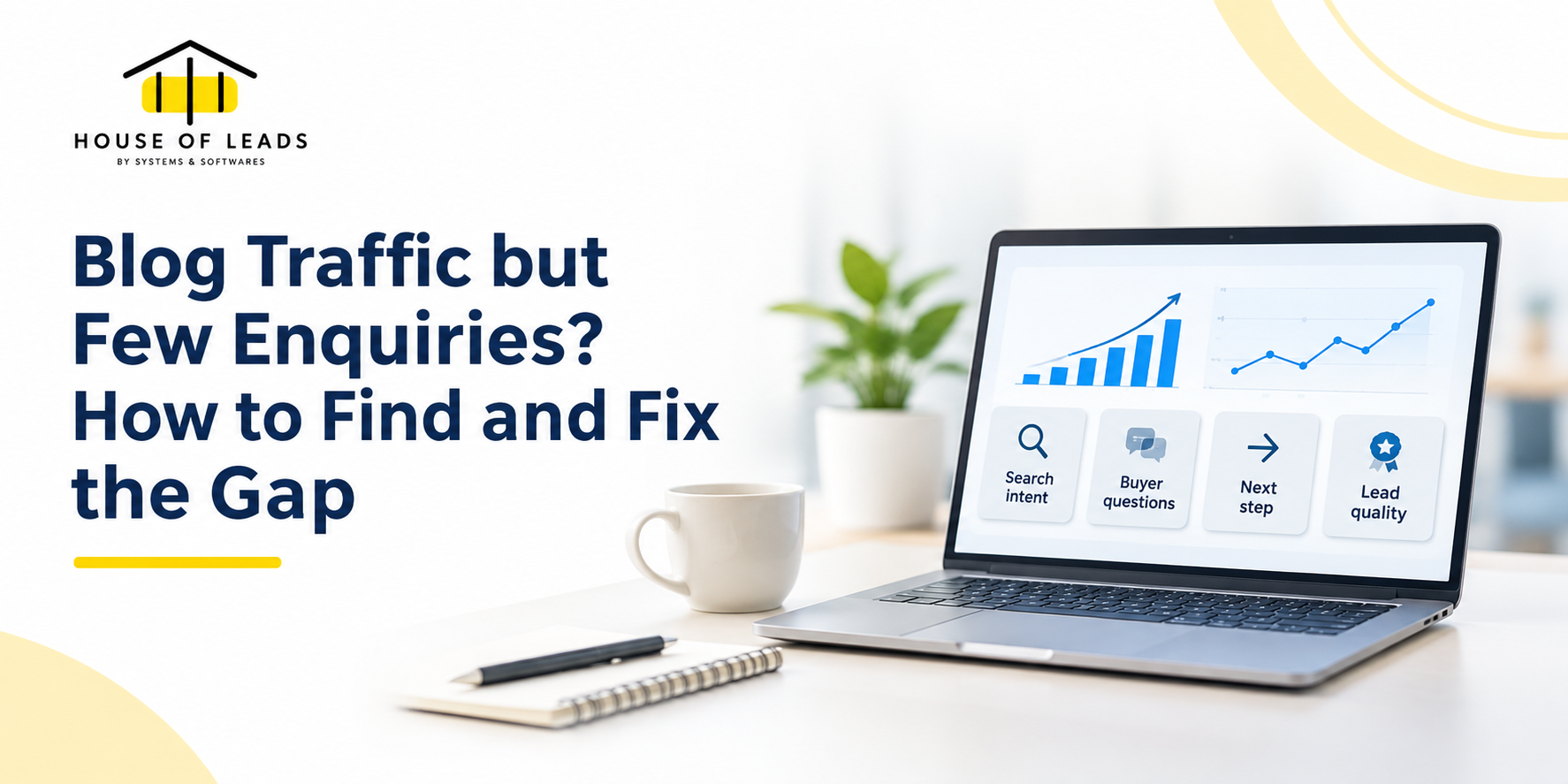
If your blog gets traffic but generates few qualified enquiries, check four things in order: who lands on the article, whether it answers a buyer’s question, where readers can go next, and whether your team can trace enquiries back to that journey. If you’re comparing content marketing services in India, use those checks to decide what to put in the brief.
A content marketing strategy defines who your content helps, what they need to know and how you’ll measure their progress. A blog can do a good job of introducing a topic while producing few immediate enquiries. The problem is worth investigating when the pages you expect to support a purchase or consultation rarely send relevant readers to the next step.
Start with one service and a few pages
Pick one service or product category that matters to the business. Pull a few articles that should help people understand or evaluate it. For each article, write down the intended reader, the decision the article helps them make and the page or action that should come next. This gives you a path to test on your own site.
Where do readers drop off?
1. Check which searches bring people in
In Google Search Console, filter the Performance report to an article and review its visible queries. Compare them with the words customers use in calls, product questions or enquiry forms. For example, a guide found through “free inventory spreadsheet” may attract people who want a template. A guide found through “inventory software for multiple stores” addresses a different need. Keep useful educational content and assess it against the job it serves.
2. Check whether the article resolves a buying doubt
Read the page as a prospective customer. Can you tell who the advice applies to, which options fit, and what you need to check before deciding? An article about moving inventory to software could include a sample list of fields to prepare, such as product identifiers and location-level stock. Ask someone who handles implementations to verify the details. A practical example often answers questions a generic list leaves open.
3. Follow the next step on your phone
Find the link a reader would use to progress. A comparison could link to the service it discusses, a product guide to the relevant collection, and an implementation guide to a setup checklist or a consultation. Open the destination, try the form or checkout, and check the confirmation. If the page explains one specific service, sending people to a general homepage makes them find it again.
4. Check whether the enquiry was recorded and qualified
Submit a test form and confirm the submission appears in analytics and reaches the team’s inbox or CRM. Check which source information survives the handoff. A click to WhatsApp tells you someone opened the channel. Your team still needs to establish whether a conversation began and whether it fits the offer. Keep test submissions out of sales reports.
Match the fix to the evidence
Use this table to scope work after checking the pages and the enquiry path.
|
What you observe |
What to test |
What to request |
|
Relevant article gets search visits but few service page visits |
Check link placement and relevance of the destination |
Improve internal links and the article’s next step |
|
Readers reach the service page but rarely enquire |
Check offer clarity, proof, form and mobile layout |
Request copywriting or website changes based on the test |
|
Enquiries arrive but sales rejects many |
Compare queries and page promises with rejection reasons |
Refine targeting, service copy and qualification fields |
|
Sales receives enquiries you cannot trace |
Test events, forms and CRM source fields |
Fix measurement before comparing content performance |
A worked example for a Kolkata service business
Imagine a Kolkata office cleaning provider that gets visits to a blog about removing stains from office chairs. Its sales team wants enquiries from facility managers for recurring cleaning contracts. It might keep the stain guide for readers who need it and build a separate guide on what to include in a commercial cleaning scope. The guide could cover floor area, shift timings and frequency, with a sample scope reviewed by the operations team.
That guide would link to the recurring office cleaning service page. The service page would explain the areas served and the information needed for a quote. A short form could capture the locality, site type and approximate size. The sales team would then record whether each request meets its service criteria. This is an illustrative workflow. Its value would be tested through relevant service page visits and qualified enquiries.
Adapt the same check for an online store or startup
An online saree store could link a fabric guide to the collection readers came to explore and measure collection visits and purchases separately. A startup selling to other businesses could link an implementation guide to a product demo page and review which booked demos turn into suitable sales conversations.
What to ask for when comparing content marketing services in India
Buy the scope that addresses the evidence. Content writing services can help when your team has approved topics, sources and a clear brief. Copywriting services are useful when a service or product page needs a clearer offer, better proof or a simpler next step. Ask for content strategy when several pages attract the wrong audience or the buyer journey spans search, website content and sales follow-up.
- Can you show which article, search intent and destination page you would investigate first?
- What does the scope include across research, writing, editing, internal links, publishing and reporting?
- Who supplies examples and verifies technical or commercial claims?
- Who implements website changes and tests whether enquiries reach sales?
- How will you separate relevant enquiries from spam, job applications or requests outside the service area?
If you’re evaluating a content marketing agency in Kolkata, ask how it would verify service areas, local terminology and buyer questions before writing. For an India-wide project, explain which markets matter and where the offer differs. Share a budget range, expected timeline and who can approve the work so proposals are easier to compare.
Make the answer clear for search and AI discovery
Put the direct answer near the top of the article and explain when it applies. Use descriptive headings, meaningful comparisons and verified examples. If you add a diagram, put the essential information in the page text as well. Give the supporting article its own purpose and link readers to the commercial page when they are ready to explore the service.
For SEO, check crawl and indexing access and ensure relevant pages can be reached through internal links. For answer engine optimisation (AEO) and generative engine optimisation (GEO), give readers concise, attributable answers and clearly explain the evidence behind them. Google’s guidance says the existing Search fundamentals apply to its AI features. Inclusion depends on Google’s systems. Google Search Central guidance
Measure leads and pipeline separately from traffic
Record the baseline before you make changes. Monitor relevant search visits, clicks from the article to the service or collection page, completed enquiries or purchases, and qualified opportunities. For consultation requests, agree what a good lead looks like using the company or site, service need, market, budget range, timeline and decision-maker. Sales should record a reason when an enquiry falls outside those criteria.
Decide how you’ll credit content. You can report opportunities where a content page was the first recorded touch and separately report those where it appeared later in the journey. Deduplicate before totalling pipeline. Visits across devices, private sharing and incomplete CRM records can leave gaps, so report unknown sources separately and avoid inferring causation from a recorded visit.
Conclusion
Start with one offer and one reader journey. If the mismatch is in the search queries, revisit the topic and audience. If buyers reach the right page but hesitate, improve the information, offer or enquiry path. If sales cannot trace the leads it receives, repair tracking before increasing the publishing budget.
If you’d like House of Leads to review where readers drop off, share your website, priority service or category, target market, budget range, timeline and decision-maker. Bring any available search and sales feedback to the consultation. Explore House of Leads’ content marketing services in India.
Frequently Asked Questions
Common causes include a mismatch between search intent and the offer, unclear next steps, form problems or incomplete tracking. Check the queries and test the path before changing the article.
Update a page when it already serves the right intent and has a fixable gap. Publish a new page when the buyer has a distinct question that an existing page cannot answer well.
Choose content writing for resources that explain a topic or help people compare options. Choose copywriting for pages where visitors need to understand an offer and take action.
Connect article visits and next-step events to available enquiry and CRM data. Review qualified opportunities and sales where the article was a recorded touchpoint, and flag gaps in the data.
No. Direct answers, credible sources and accessible pages support discoverability. Record citations only when you observe them, with the platform, query and date.

Article by
Piyush Sethia
Co-Founder | Content Marketer and Strategist
Recognised as the 2026 Tally MSME Business ‘Tech Transformer’ Award winner, Piyush Sethia leverages advanced tech facilities to transform content marketing and writing efficiency. With over a decade of experience, he specializes in data-backed content marketing, AIO, GEO, SEO strategy, and organic growth blueprints. He is also the author of The Clarity of Confusion, showcasing his unique ability of storytelling and simplifyinig complex landscapes into crystal-clear narratives. His expertise lies in converting technical data and deep audience insights into engaging, search-optimized strategies that drive sustainable traffic.