

To turn sales questions into a B2B content calendar, collect the questions prospects ask before they buy. Group them by the decision they help buyers make, then prioritise them by frequency, impact on deals and the evidence you can share. Give each question a format, an owner, a due date and a way to measure whether the answer helped.
A B2B content calendar ties each planned piece to a buyer decision. A sales call might surface “Can we keep our existing website?” The calendar turns that into a named page update or article, with someone responsible for getting a verified answer live.
Why use sales questions to plan B2B content?
Buyers often do substantial research before speaking to sales. In its 2024 survey of 2,509 recent B2B buyers across North America, EMEA and Asia-Pacific, 6sense found that 81% had chosen a preferred vendor and 85% had largely set their purchase requirements before contacting sales. 6sense 2024 B2B Buyer Experience Report
McKinsey’s 2024 B2B Pulse survey, which gathered responses from nearly 4,000 decision-makers across 13 countries, found that B2B customers used an average of 10 interaction channels during buying. Start by making a useful answer easy to find on your website and easy for sales to share in a follow-up. McKinsey 2024 B2B Pulse
These figures describe the surveyed groups. Your own enquiry and deal records should guide what to publish first.
Which sales questions should come first?
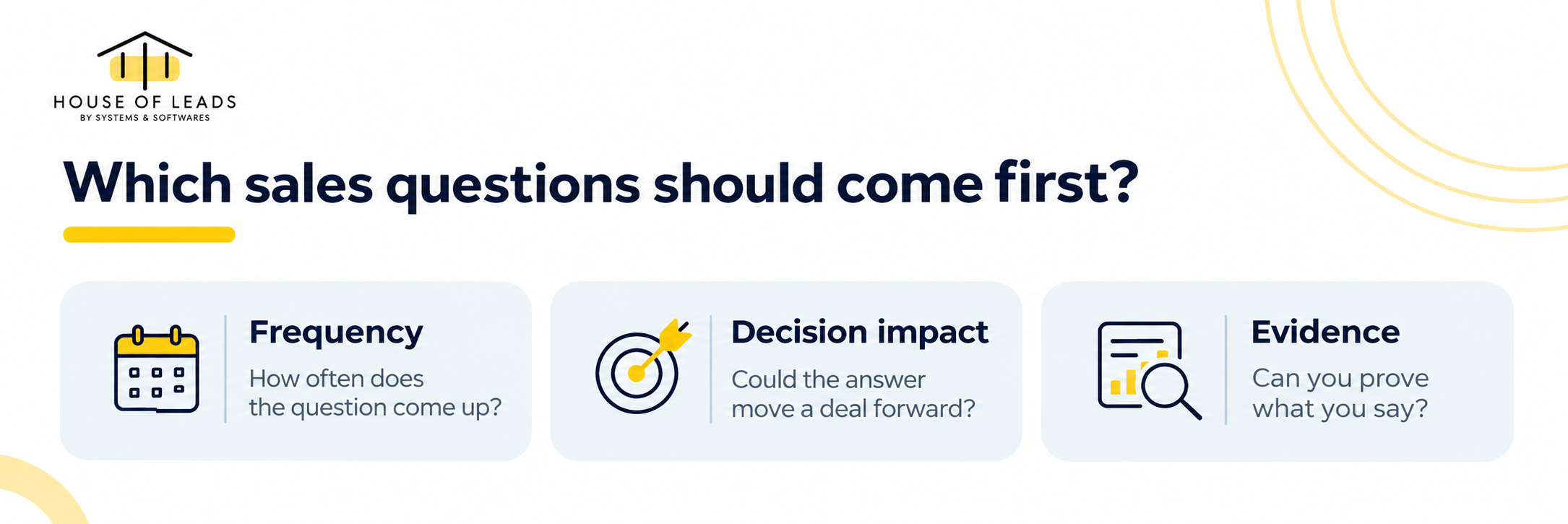
Start with repeated questions from buyers who fit your offer. Give extra weight to questions that slow down a deal and that your team can answer with evidence.
Collect buyer questions in their own words
Review discovery calls, proposal emails, enquiry forms and CRM lost-deal notes. Ask sales which questions they answer repeatedly and what buyers need to take back to their teams. Save the exact wording, buyer role, deal stage and source. Remove client names and sensitive details before sharing notes with writers.
Group questions by the decision they support
- Fit. Can you work with our existing website or team?
- Evaluation. What is included, and how do we compare two proposals?
- Approval. What will it cost, who needs to sign off and what do we need to provide?
- Delivery. Who approves each piece, and what happens when feedback arrives late?
Score the questions and assign a reviewer
Give each question 0–2 points for frequency, impact on a deal and evidence. For frequency, use 0 for an internal hunch, 1 for one recorded enquiry and 2 for repeated enquiries. For impact, use 0 for general interest, 1 for useful context and 2 for a question that blocks a decision. For evidence, use 0 if it is missing, 1 if it needs review and 2 if it is approved for public use.
Sort by total score. If scores tie, start with the question that blocks more qualified opportunities. Assign a reviewer to questions with missing evidence before scheduling them. A low-frequency question may still be worth answering when it repeatedly surfaces at proposal approval for the accounts you want to win.
Where should each answer live?
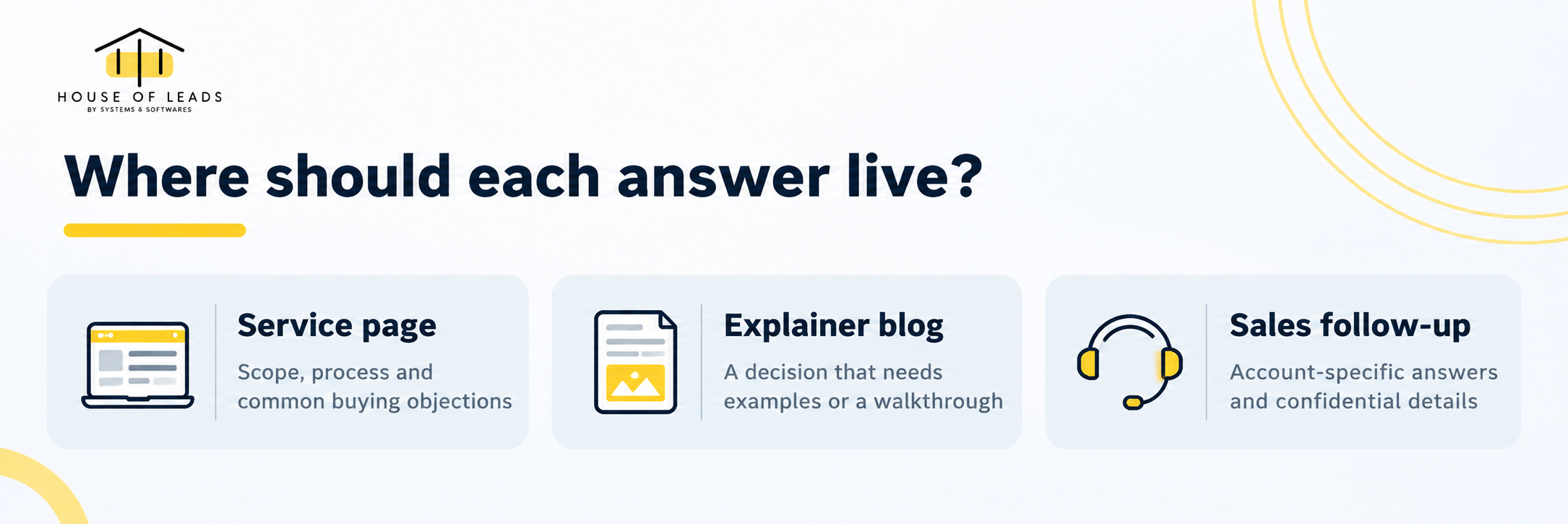
Use the service page for questions buyers ask about your offer. Write a standalone blog when buyers need a framework, checklist or worked example. Keep account-specific answers in a sales follow-up or proposal.
- Update the service page when buyers ask what is included, who the service is for or what happens after they enquire.
- Publish a guide when buyers need to compare options or complete a task. Link to the service page where the reader can act on what they learned.
- Give sales a short reply with an approved link. Keep quote details, private examples and customer-specific terms in the appropriate sales channel.
Check your existing pages before creating a new URL. If a page already answers the same question for the same reader, improve that page and give sales a direct link to the relevant section.
What does a four-week B2B content calendar look like?
This example follows a packaging supplier that sells custom boxes to Indian e-commerce businesses. The questions, assignments and publishing targets are illustrative.
Week and sales question | Asset and owner | Evidence and review | Next step |
|---|---|---|---|
1 · Can you work with our box sizes? | Service page FAQ · Marketing | Supported specifications · Production lead | Send box dimensions |
2 · How do we compare two packaging quotes? | Comparison guide · Writer | Itemised quote template · Sales lead | Request an itemised quote |
3 · Can we approve a sample before ordering? | Service page process update · Website editor | Approved sample policy · Operations lead | Ask about sampling |
4 · What should we send to get a quote? | Website checklist and sales email · Marketing | Enquiry form fields · Sales lead | Send a complete brief |
In the working sheet, add a publish date, review deadline, status, live URL and success measure to every row. For week four, for example, track how many enquiries include dimensions, quantity and the required delivery date.
How do you measure whether the calendar helps sales?
Track whether the right buyers find the content, whether sales uses it and whether enquiries become qualified opportunities.
- Search discovery. In Google Search Console, review impressions, clicks and the queries that surface each URL. Use query data to refine wording and spot gaps.
- Enquiries and sales use. In GA4, track clicks to the service page and completed enquiry forms where tracking is configured. Ask sales to log which published assets they send and which objections buyers raise afterwards.
- Lead quality and pipeline. Record company and website, service need, market, budget range, timeline and decision-maker or approver in your CRM. Tie enquiries to opportunities where records allow. Report sourced pipeline and assisted pipeline separately, with a clear attribution rule.
Review the calendar with sales each month. Check whether a published answer reduced repeat explanations or improved the information buyers supplied. Keep the attribution label unknown when you cannot connect an enquiry to an asset.
What should buyers look for in content marketing services in India?
Ask how the agency will collect sales questions, decide which pages to update and verify claims before publication. Whether you are comparing a content marketing agency in Kolkata or working with a team elsewhere in India, ask to see a sample calendar row with the buyer question, format, reviewer and success measure.
Content writing services can cover articles, guides and case studies. Copywriting services can cover service pages, landing pages and calls to action. For a wider content marketing strategy, agree who owns research, briefs, publishing, distribution, reporting and updates. Your sales team will still need to supply examples, clarify policies and review technical claims.
House of Leads lists audience research, editorial planning, SEO blogs, website and landing page copy, content refreshes and reporting among its content marketing services in India. If you are setting a budget, see the guide to content marketing costs in India.
Conclusion
Take five questions from recent sales conversations. Pick the one that most often holds up a decision and assign it to the person who can verify the answer. Give the finished answer a home on your website and share it with sales. If you want help planning or writing the first month, request a content consultation with House of Leads and bring those five questions along.