
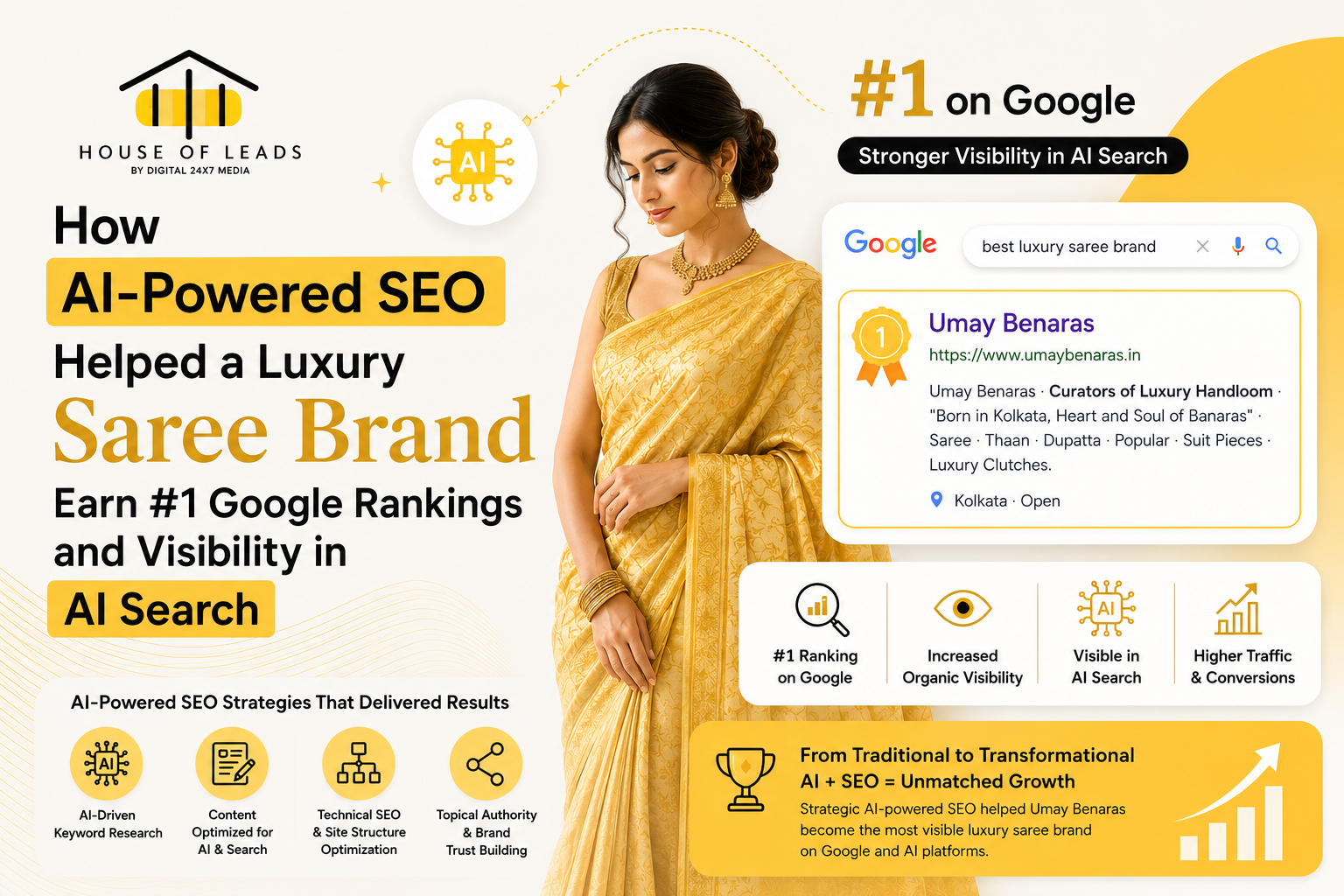
A luxury saree brand improved its organic search performance by combining technical SEO, intent-led content, stronger internal linking, authority signals and content designed to answer specific customer questions clearly. The campaign moved selected priority queries to #1 positions on Google and strengthened the brand’s presence in AI-powered search experiences. The key was not a separate “AI trick” — it was stronger, more useful and more verifiable SEO.
Key Takeaways
- The campaign focused on search intent and topical authority rather than repeating the same commercial keyword across many pages.
- Technical fixes, content quality, internal linking and evidence worked together; no single tactic produced the result alone.
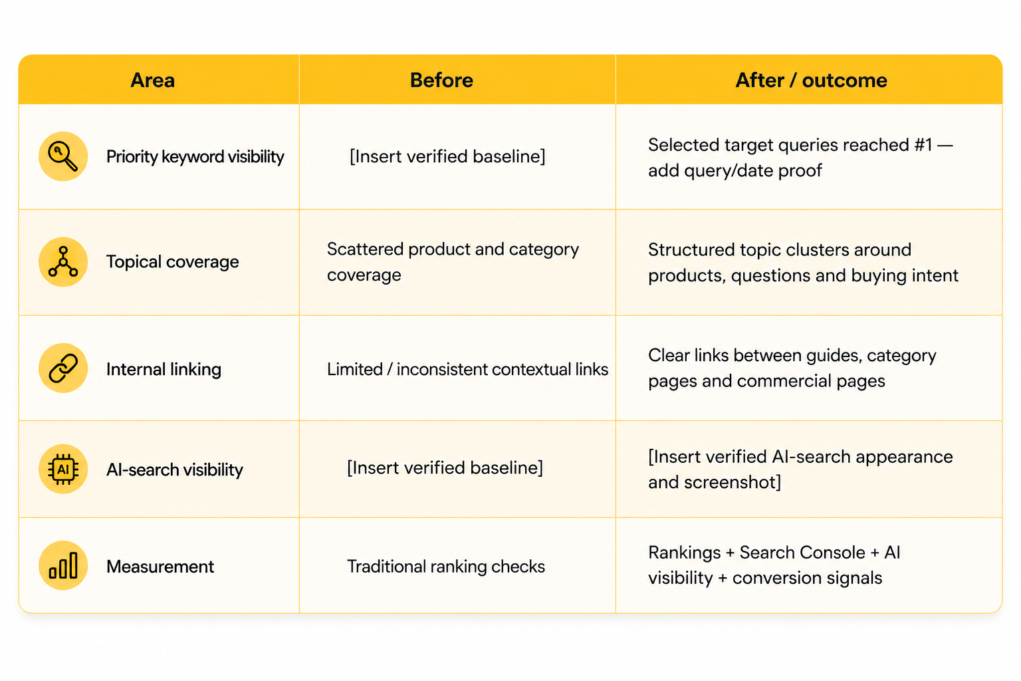
- Selected priority keywords reached #1 positions. Insert the verified query-level evidence before publication.
- AI-search visibility was treated as an extension of strong SEO, not as a separate shortcut.
- The same framework can be adapted by ecommerce and service businesses that need sustainable organic visibility.
The Challenge: A Premium Product Was Not Getting Premium Search Visibility
The saree brand had a strong product proposition, visual appeal and an audience that actively searched online before buying. Yet its search presence did not fully reflect the quality of the business. Important category and product-intent searches were either dominated by larger competitors or answered by marketplaces, publishers and established ecommerce domains.
That created a common growth problem: people could be interested in the product category without discovering the brand at the moment they were comparing styles, materials, buying options or trusted sellers. At the same time, search behaviour was becoming more conversational. Customers were not only typing short keywords. They were asking longer questions in Google, AI Overviews, AI Mode and AI assistants.
The SEO goal therefore had two parts: improve classic rankings for commercially useful searches and make the brand’s content easier to retrieve, understand and reference in AI-driven search experiences.
Campaign Snapshot
What “AI-Powered SEO” Meant in This Campaign
AI-powered SEO did not mean publishing hundreds of machine-written pages. It meant using AI-assisted research and analysis where useful, while keeping strategy, evidence, editing and brand experience at the centre of the work. Google’s current guidance is clear that the same core SEO best practices remain relevant for AI Overviews and AI Mode, and that there are no special technical requirements beyond being eligible for normal Search and snippets.
- Map real customer questions and long-tail searches around saree types, fabrics, occasions, styling, care and purchase intent.
- Identify gaps where competitors answered a query better or more completely.
- Build clear article and page structures that answer the main question early and then add depth.
- Strengthen entity context around the brand, products, categories and expertise.
- Use first-party product knowledge, original imagery and campaign evidence to make pages harder to replicate.
- Connect informational content to category and service pages through contextual internal links.
- Measure both classic search visibility and emerging AI-search visibility.
Step 1: We Separated Commercial Keywords from Informational Questions
One of the most important decisions was preventing every page from chasing the same broad keyword. Commercial pages were kept focused on purchase-ready searches. Supporting content addressed narrower questions customers ask before they buy.
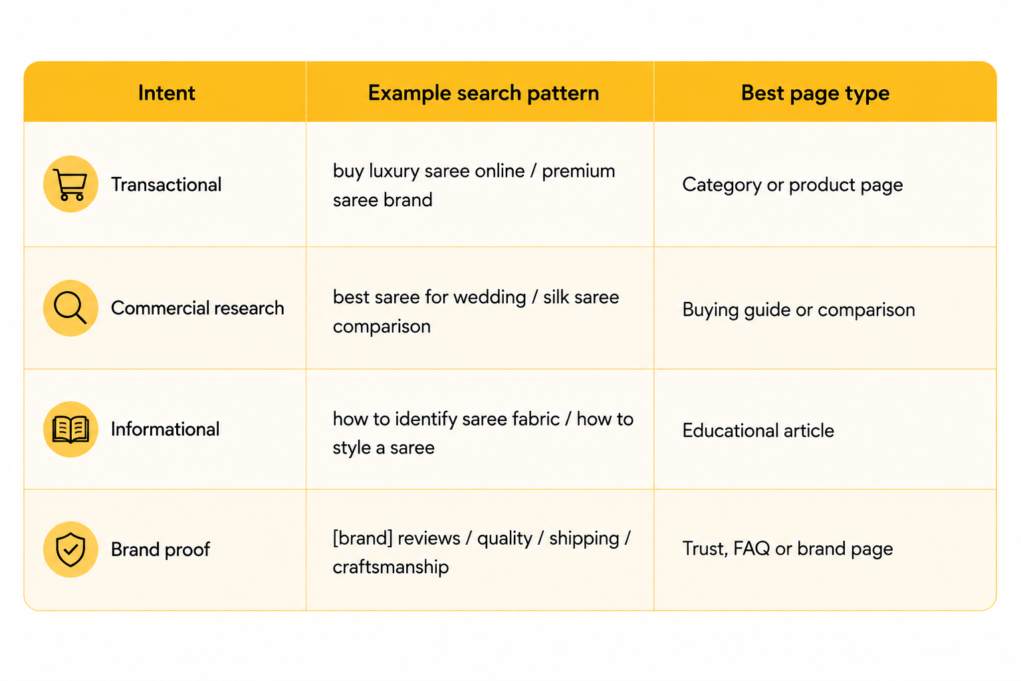
This reduced keyword cannibalization and gave Google clearer signals about which page should satisfy each type of search. It also created more useful retrieval candidates for longer, conversational AI queries.
Step 2: We Built Topic Clusters Instead of Isolated Blogs
Rather than publishing unrelated articles, the content was organised into clusters. A central topic page connected to supporting questions, and those supporting pages linked back to the relevant commercial destination. This helped users move naturally from learning to evaluating to buying.
- Fabric and craftsmanship guides connected to relevant collection pages.
- Occasion-based articles connected to wedding, festive or gifting categories.
- Care and styling content built trust without forcing an immediate sale.
- Case-study and proof content reinforced the brand’s expertise and real-world credibility.
Step 3: We Reworked Content for Direct Answers and Deeper Evidence
Pages were made easier to understand quickly. The main answer appeared near the top, headings reflected real questions, and important claims were supported with examples, product context or evidence. That matters because both users and retrieval systems need to identify the useful part of a page without working through vague introductions.
Google recommends original, substantial and people-first content, with clear sourcing and first-hand expertise. Bing similarly recommends clear headings, tables, FAQs, examples, data and cited sources because these make content easier for AI systems to reference accurately.
Step 4: We Strengthened Technical and On-Page SEO
- Reviewed indexability, canonicals, redirects and sitemap coverage.
- Improved title tags and meta descriptions around actual search intent.
- Cleaned heading hierarchy so each page had one clear primary topic.
- Improved image filenames, alt text and surrounding context for product visuals.
- Strengthened internal anchor text and reduced orphaned content.
- Improved page experience issues that could interfere with crawling or usability.
These fundamentals are still essential. Google states that pages need to be indexed and eligible to appear in Search with a snippet before they can be shown as supporting links in AI Overviews or AI Mode.
Step 5: We Made the Brand Easier to Trust
Ranking content is easier to sustain when the site makes it clear who is behind the information and why the content is credible. We therefore treated trust signals as part of SEO, not as decoration.
- Clear author or reviewer information on editorial content.
- Consistent brand and business information across key pages.
- Original product visuals rather than generic stock imagery where possible.
- Evidence for measurable claims and campaign results.
- Strong About, Contact, policy and customer-assurance information.
- Dates and updates used only when the content was genuinely reviewed or changed.
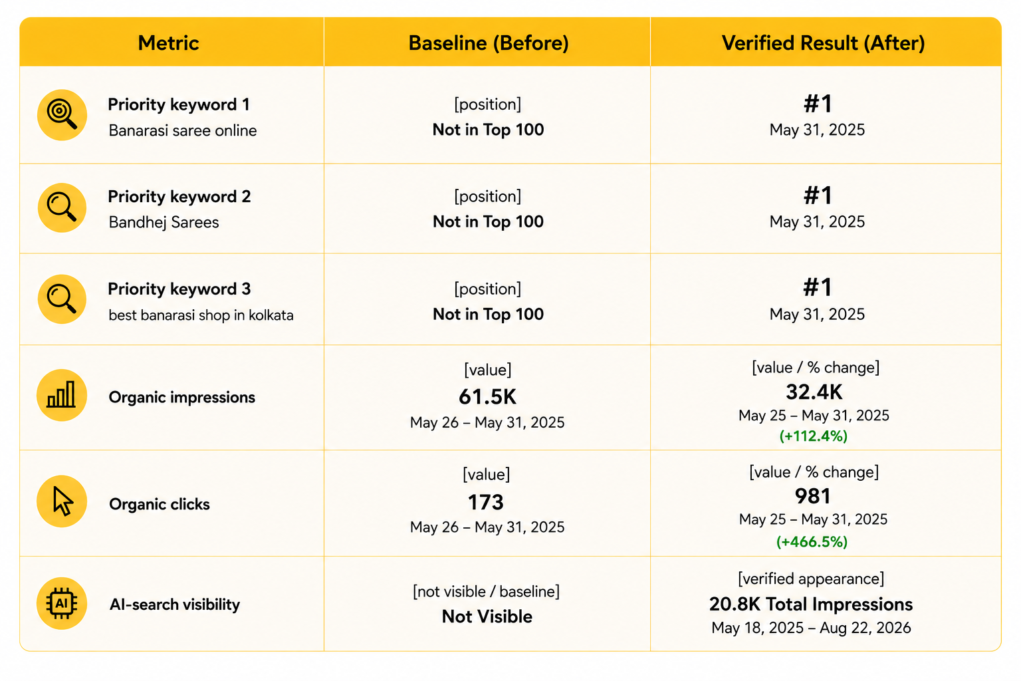
The important lesson is not that one keyword reached one position. The stronger result was that the site became more useful across a broader set of discovery journeys: classic search, long-tail questions, product research and AI-assisted search.
Why This Approach Can Improve AI Search Visibility
There is no guaranteed formula that forces a brand into an AI answer. Google explicitly says there are no additional special optimizations required for its AI features beyond strong SEO fundamentals. OpenAI likewise states that placement in ChatGPT search is not guaranteed. However, a site can improve eligibility and usefulness by making its content crawlable, reliable, specific and easy to understand.
- Answer a specific question clearly instead of surrounding it with generic marketing language.
- Use original data, examples, screenshots and first-party experience.
- Keep facts current and cite primary sources for external statistics.
- Use descriptive headings, concise definitions, lists and tables where they genuinely help.
- Make important pages crawlable and indexable; allow relevant search crawlers where appropriate.
- Build a coherent subject area so the website repeatedly demonstrates expertise on related questions.
What Businesses Can Learn from This SEO Case Study
- Do not make every page compete for the same commercial keyword. Give each page one clear job.
- Build content clusters around the questions customers ask before, during and after purchase.
- Treat AI visibility as an outcome of strong, retrievable, evidence-backed content — not a separate gimmick.
- Show proof. A screenshot, query, date and methodology are more convincing than a large claim with no context.
- Measure rankings alongside impressions, clicks, qualified traffic, enquiries and sales.
How House of Leads Approaches SEO for AI-Driven Search
At House of Leads, we combine technical SEO, search-intent mapping, content strategy, internal linking, authority building and measurable campaign reporting. The objective is not to chase every algorithm change. It is to build a website that search engines can understand and customers can trust.
Start with the broader guide: A Complete Guide for Businesses to Build Search Visibility, Customer Trust and AI-Powered Search Presence
Explore the service: SEO Services in India by House of Leads
Get a Free SEO & AI Visibility Review → Contact House of Leads
References
Frequently Asked Questions
AI-powered SEO uses automation and AI-assisted research where useful, but still relies on core SEO fundamentals such as technical accessibility, search intent, original content, internal linking, authority and measurement.
GEO focuses on how content participates in AI-generated answers and citations. In practice, strong SEO remains the foundation. Google says its generative AI features are rooted in core Search ranking and quality systems.
No. Neither traditional rankings nor AI citations can be guaranteed. A good strategy improves eligibility, relevance, authority and retrievability, then measures actual visibility over time.
It should show the exact query, date, location or device context where relevant, before-and-after metrics, screenshots, the campaign period and how the result was measured.
Timelines vary by competition, site condition, content depth and authority. Technical fixes can be discovered quickly, while ranking, citation and conversion improvements usually need sustained work and measurement.
Yes. House of Leads offers SEO services covering planning, on-page SEO, technical improvements, content strategy, internal linking, off-page work and reporting for businesses seeking organic visibility.
If your website ranks for a few terms but still struggles to generate consistent organic enquiries, the problem may be deeper than keywords. House of Leads can review your technical SEO, content gaps, internal linking, search visibility and AI-search readiness, then identify the highest-impact opportunities first.
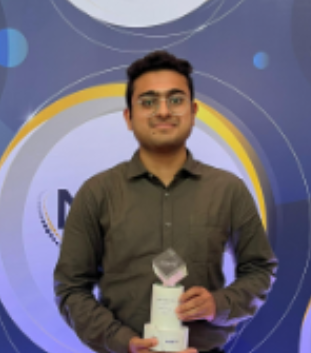
Article by
Anuj Poddar
Co-Founder | Content Marketer and Strategist
Anuj is the co-founder of House of Leads, a company dedicated to organic social media marketing that helps businesses grow sustainably — without relying on paid ads or boosted posts. Recognized with the New Gen Icon award at the MSME Honours, Anuj has built a reputation for driving real, measurable results through purely organic strategies.
Under his leadership, House of Leads has produced hundreds of viral reels that have generated thousands of enquiries, translating into actual sales for clients across industries. Beyond digital engagement, his campaigns have also driven tangible increases in store footfall, proving that organic content can move people from screens to storefronts.
Anuj’s approach starts with a deep dive into the target audience, followed by a thorough study of the product or service itself. This research-driven foundation allows him to craft genuinely relatable content that resonates — turning everyday viewers into loyal customers, and brands into recognizable names, all without spending a rupee on ads.


